

The Short Answer: The most common signs of a bad throttle position sensor include erratic idle, dead spots when you press the gas pedal, a check engine light, hesitation or surging at cruise, poor fuel efficiency, stumbling on acceleration, and stalling or hanging RPM when returning to idle. All seven point back to the same root cause: the TPS is sending bad data to the ECU, and the ECU can’t make the right fueling and timing decisions without it.
The throttle body sensor, technically called the throttle position sensor or TPS, tells the ECU how far the throttle plate is open. Every fueling decision, every timing adjustment, and every idle correction the ECU makes depends on that reading being accurate. When it’s off, everything downstream is off too.
The problem is that TPS failure symptoms overlap with a lot of other issues. Erratic idle gets blamed on vacuum leaks. Hesitation gets blamed on the fuel pump or spark plugs. Dead spots get blamed on the throttle cable. Before you start chasing those, check the sensor that feeds the ECU its throttle data is correct.
How the Throttle Position Sensor Works
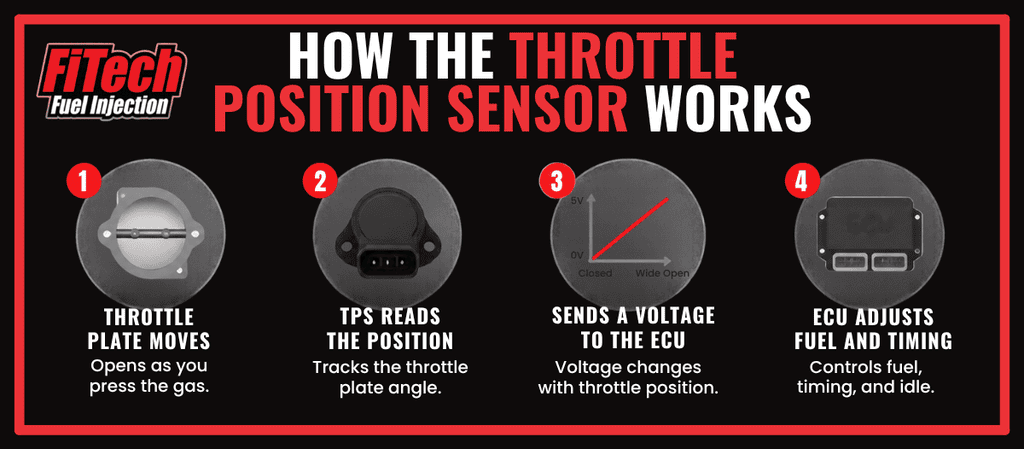
The TPS is mounted on the throttle body, directly on the throttle shaft that connects to the throttle plate. The throttle plate is a butterfly valve that controls how much air enters the intake manifold.
The sensor reads the angle of the throttle plate and sends a voltage output to the ECU. At idle, the TPS reads near-zero, meaning the throttle is closed. At full throttle, it reads maximum voltage. The ECU uses this data to determine fuel delivery, ignition timing, idle speed, and accel enrichment.
Cable vs. Drive-by-Wire
On a cable throttle system, the throttle cable physically opens the plate and the TPS reports its position. On a drive-by-wire system, the ECU controls the throttle plate directly using input from the pedal position sensor on the gas pedal assembly. Either way, the ECU depends on accurate throttle position data from the TPS to make every fueling and timing decision.
7 Signs Your TPS Is Failing
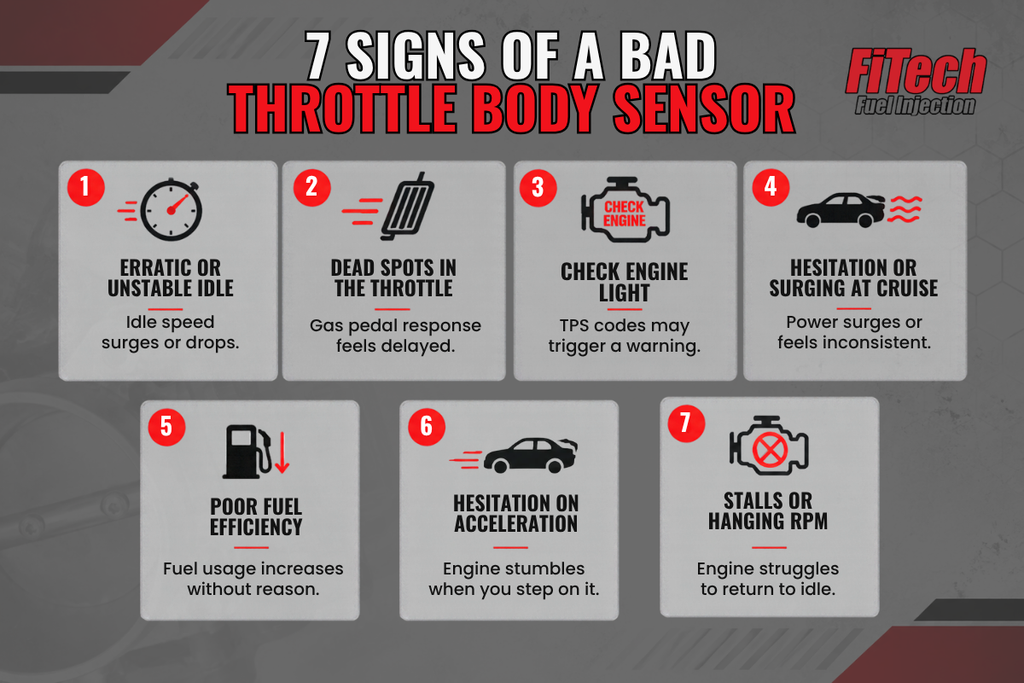
1. Erratic or Unstable Idle
Idle speed bounces, surges, or drops unexpectedly. The ECU is getting inconsistent throttle position data and can’t maintain stable idle control. This is often misdiagnosed as a vacuum leak or IAC issue. If the idle is erratic, check the TPS voltage readings at closed throttle before chasing air leaks.
2. Dead Spots in the Throttle
You press the gas pedal, and nothing happens, then the engine catches up and you jump forward. This is one of the most common symptoms of a failing TPS. The sensor often has a worn or dirty section on its internal resistive track that produces an incorrect signal or no signal at all. The ECU doesn’t see the throttle input and doesn’t add fuel. The dead spot is usually at a specific pedal position and is repeatable.
3. Check Engine Light
A faulty throttle position sensor will often trigger a check engine light with a TPS-related diagnostic code. Common codes include P0121 (TPS range/performance), P0122 (TPS circuit low), and P0123 (TPS circuit high). The check engine light may also come on and off intermittently if the sensor is failing gradually rather than all at once.
4. Hesitation or Surging at Cruise
The engine surges or bucks despite a steady throttle instead of maintaining consistent power. The TPS is sending fluctuating voltage to the ECU, which adjusts fueling up and down in response. This often shows up at part-throttle cruise where small voltage changes have a bigger effect on fueling. Cruise control may also behave erratically or disengage if the TPS signal is unstable.
5. Poor Fuel Efficiency
A bad TPS can cause the ECU to run richer or leaner than intended across the operating range. If the sensor reads higher than the actual throttle position, the ECU delivers more fuel than needed. Over time, this shows up as noticeably worse fuel efficiency with no other explanation. If your fuel consumption has increased and nothing else has changed, the TPS is worth checking.
6. Hesitation or Stumble on Acceleration
When you step on the accelerator pedal, the engine bogs, stumbles, or hesitates before responding. The TPS isn’t reporting the throttle change fast enough or accurately enough for the ECU to add acceleration enrichment. This is similar to a dead spot but happens specifically during quick throttle changes rather than at a fixed position. It’s often misdiagnosed as a fuel pump, fuel filter, or spark plug issue.
7. Engine Stalls or Won’t Return to Idle
After blipping the throttle or coming to a stop, the engine stalls or hangs at high RPM before slowly returning to idle. The TPS is either sticking, sending a delayed signal, or not reading the closed-throttle position correctly. If the TPS doesn’t tell the ECU the throttle is closed, the ECU keeps fueling as if the throttle is open.
Check the TPS reading with the engine off and your foot off the pedal. If it shows something like 25% throttle position instead of near zero, or reads in the negatives, the sensor has failed or was installed incorrectly.
What to Check Before Replacing the TPS
Rule Out Other Issues First
A bad TPS isn’t always the sensor itself. Other issues cause similar symptoms, and checking these first can save you from replacing a sensor that isn’t the problem.
- Vacuum leak: Unmetered air entering the intake manifold causes erratic idle and lean conditions that mimic a bad TPS
- Dirty throttle body: Carbon buildup on the throttle plate can restrict airflow and cause idle issues. Clean the throttle body before assuming the sensor is bad
- Loose or corroded electrical connection: A bad connection at the TPS plug can cause intermittent signal loss that looks exactly like a faulty sensor. Clean the connector and check the wiring before replacing anything
- Clogged air filter: Restricted airflow can cause performance issues that feel like throttle problems. Replace the filter and recheck before moving to sensor diagnosis
- Bad MAP sensor or oxygen sensor: Incorrect data from either of these can cause symptoms that overlap with TPS failure. Check all sensor readings, not just the TPS
Loose or corroded electrical connection at the TPS plug. A bad connection can cause intermittent signal loss that looks exactly like a faulty throttle position sensor. Always inspect the wiring and connector for damage before replacing the sensor
When to Replace
If the voltage output is erratic, out of range, or has dead spots when you sweep the throttle slowly from closed to full throttle, the TPS needs to be replaced.
On our throttle body EFI systems, the TPS is built into the throttle body. Replacement sensors are available, and the swap is straightforward without removing the throttle body from the intake manifold. After installing a new sensor, confirm the TPS voltage reads correctly at idle and at full throttle before driving.
Don’t Chase the Wrong Problem
A bad TPS affects everything the ECU does. It’s one of the primary inputs for fueling, timing, and idle control. If you’re chasing erratic idle, dead spots, hesitation, or a check engine light, check the TPS before tearing into the fuel system or ignition. The test takes a few minutes with a multimeter, and it’ll tell you exactly if the sensor is the issue or if you need to keep looking.
Not sure what you’re dealing with? Call our tech team at (951) 340-2624, and we’ll help you diagnose it.
Frequently Asked Questions
Can a bad TPS damage my engine?
A bad TPS won’t cause direct mechanical damage, but the incorrect fueling it causes can lead to lean conditions, misfires, and poor combustion over time. Replacing a failing TPS early prevents bigger driveability problems later on.
How do I test my throttle position sensor?
Use a multimeter to check voltage output at the TPS connector. At closed throttle, the reading should be near the low end of the range (around 0.5V). At full throttle, it should be near the high end (around 4.5V). Sweep the throttle slowly and watch for dropouts, dead spots, or erratic jumps in the reading.
Can I clean a throttle position sensor instead of replacing it?
Cleaning the electrical connection and plug can fix issues caused by corrosion or dirt at the connector. But if the sensor’s internal resistive track is worn or damaged, cleaning won’t fix it. The sensor needs to be replaced with a new one.
What’s the difference between a TPS and a pedal position sensor
A TPS is mounted on the throttle body and reads the position of the throttle plate. A pedal position sensor is mounted on the gas pedal assembly and reads how far the driver has pressed the accelerator pedal. On a drive-by-wire system, both are present. On a cable throttle system, only the TPS is used.
Does FiTech sell replacement throttle position sensors?
Yes. Our throttle body EFI systems have the TPS built in, and replacement sensors are available. The swap is straightforward and doesn’t require removing the throttle body from the intake manifold.