
The Short Answer: Set your ohmmeter to the ohms resistance scale, disconnect the spark plug wire from both ends, and touch one probe to each end of the wire. Compare the resistance reading to the manufacturer’s spec, which is typically listed as ohms per foot. If the reading is significantly higher than spec, the wire is usually bad. If there’s no reading at all, the wire has an internal break and needs to be replaced.
A bad spark plug wire can cause misfires, rough idle, hesitation, and a check engine light with a misfire code. The problem is that these symptoms look exactly like a bad coil, a fouled spark plug, or even a fueling issue. Before you start swapping parts, test the wires. A basic ohm meter or multimeter is all you need, and the test takes a few minutes per wire.
This guide walks through how to test your plug wires, what the resistance readings mean, what causes wires to go bad, and when it’s time to replace them.
Why Spark Plug Wires Fail
What the Wire Actually Does
A spark plug wire carries high voltage from the ignition coil or distributor cap to the spark plug. On a distributor-based ignition system, the coil sends high voltage to the distributor cap, and the cap routes it to each plug wire in firing order. On a coil pack or coil-on-plug setup, the wire runs directly from the coil to the plug.
The wire is part of the secondary circuit, which is the high-voltage side of the ignition system. The secondary circuit carries thousands of volts from the coil to the spark plug end, and the wire’s job is to deliver that firing voltage with minimal resistance and no leakage.
What Goes Wrong
Spark plug wires degrade over time. Heat, vibration, oil exposure, and age all take a toll. Here’s what happens:
- High resistance builds up inside the wire as the conductor breaks down, which reduces the spark energy reaching the plug
- Cracked or brittle insulation allows the spark to arc to ground before it reaches the plug, especially near headers or metal brackets
- Burned or melted boots at the spark plug end or distributor cap terminal lose their seal and allow moisture, dirt, and arcing
- RF interference increases as wire insulation degrades, which can affect ECU sensor readings on EFI-equipped engines
- Solid core wires can cause RF interference with EFI electronics even when new, which is why spiral core or suppression wires are recommended for any EFI build
Factory wires and OEM wires on older vehicles are often the original set with decades of heat cycles on them. Even if they look fine on the outside, the internal conductor may be breaking down.
How to Test Spark Plug Wires
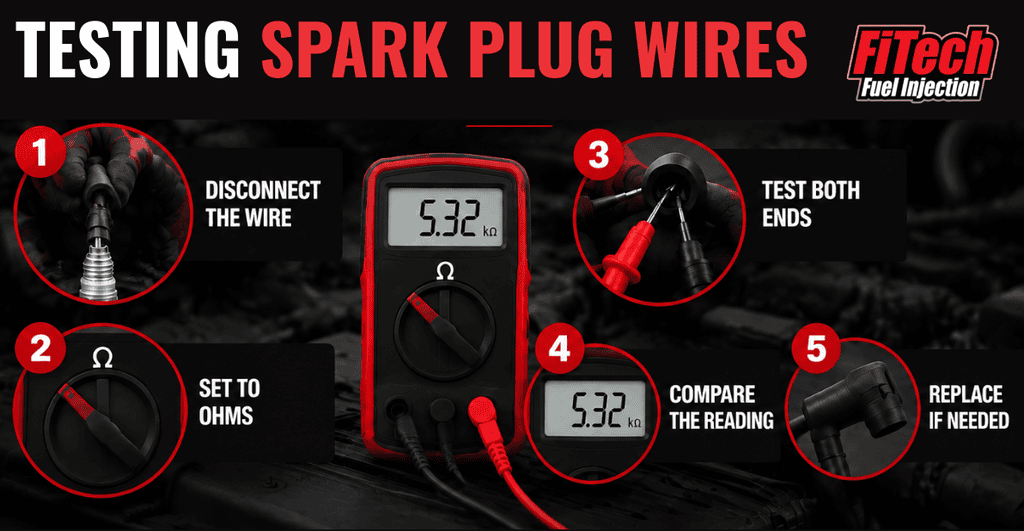
What You Need:
- A multimeter or ohm meter set to the ohms resistance scale
- Your vehicle’s service manual or wire manufacturer’s spec for resistance per foot
- A spray bottle with water (for the optional visual arc test)
Step-by-Step Resistance Test
This test measures the resistance of each plug wire to see if it falls within spec. High resistance means the wire is degrading and not delivering full spark energy to the plug.
1. Turn the Engine Off and Let It Cool
Never test spark plug wires on a running engine. The secondary circuit carries thousands of volts. Let the engine cool before handling any ignition wires.
2. Remove One Wire at a Time
Pull the wire from the spark plug end first, then from the distributor cap or coil. Only remove one wire at a time so you don’t mix up the firing order. Grab the boot, not the wire itself, to avoid damaging the conductor inside.
3. Set the Multimeter to Ohms
Set your ohmmeter to the appropriate ohms resistance scale. For most spark plug wires, the 20K ohm range works. If you’re not sure, start with a higher range and work down.
4. Touch One Probe to Each End
Place one probe on the metal terminal inside the plug cap at the spark plug end. Place the other probe on the metal terminal at the distributor cap terminal or coil end. The multimeter will display the resistance reading in ohms.
5. Compare to Spec
Most suppression-type plug wires have a spec between 3,000 and 12,000 ohms per foot. Multiply the spec by the wire length to get the expected total resistance. A new wire that’s two feet long at 5,000 ohms per foot should read around 10,000 ohms total.
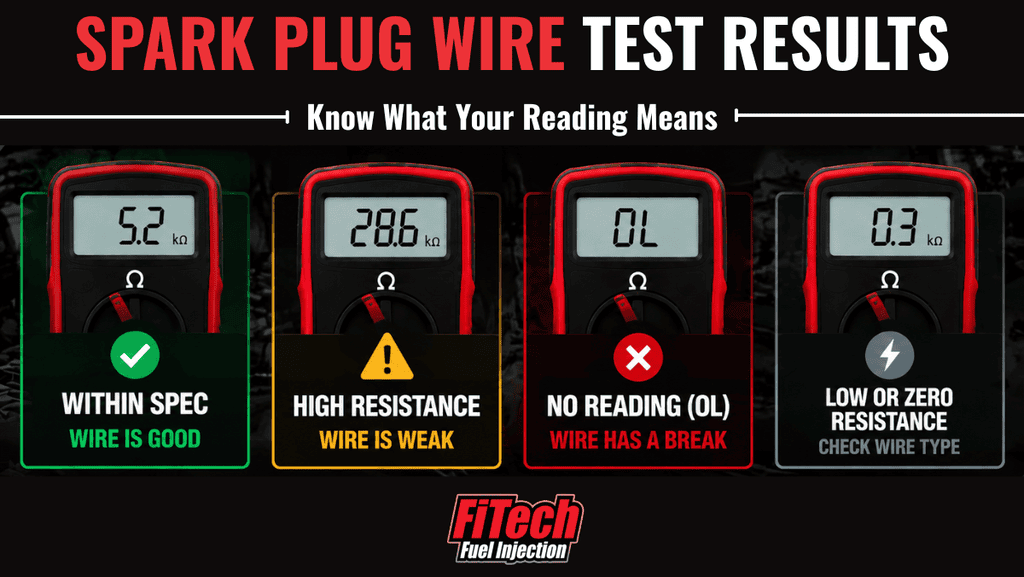
What the reading tells you:
- Within spec: the wire is good
- Higher than spec: the wire’s conductor is degrading and should be replaced
- No reading (infinite/OL): the wire has an internal break and is dead. Replace it
- Very low or zero resistance: you may have a solid core wire, which works for points-based ignition but causes RF interference with EFI systems
Spark plug wire resistance depends on the core type and scales with wire length. Carbon core suppression wires run roughly 3,000 to 12,000 ohms per foot. Spiral core wires read much lower, often a few hundred to about 1,500 ohms per foot, because they cut resistance while still suppressing noise. If you’re running our Go Spark Ferro-Spiral core wires, a reading on the low end is normal and by design.
6. Repeat for Every Wire
Test each plug wire individually, write down the resistance readings, and compare them to each other. All wires should read within a similar range relative to their length. One wire with significantly higher resistance than the others is the likely source of a misfire.
Don’t forget to test the coil wire that runs from the coil to the distributor cap. It carries spark to all cylinders, so if it’s high resistance, every cylinder suffers.
When to Replace Your Spark Plug Wires
Signs It’s Time
- One or more wires reading high resistance compared to spec or compared to the other wires
- A wire has no continuity (open circuit)
- Visible cracking, burn marks, or melted boots on any wire
- Misfires or rough idle that track to a specific cylinder and don’t improve with a new plug or coil swap
- A check engine light with a misfire code that clears but comes back
- Arcing visible during the spray bottle test or in a dark engine bay
What to Replace Them With
Not all plug wires are the same. For EFI-equipped engines, wire selection matters more than it did on a carbureted setup.
- Use spiral core or suppression wires, not solid core wires. Solid core wires cause RF interference that can disrupt ECU sensor readings and cause drivability issues on EFI systems
- Match the wire resistance to your ignition system. Lower resistance delivers more spark energy, but too low can cause RF noise. Check your coil and ignition module specs
- Heat matters. Wires routed near headers need boots that can handle the increased temperature without melting
Our Go Spark spark plug wires use an 8mm Ferro-Spiral core for low resistance and high noise suppression, with ceramic boots rated to 2,000 degrees F. Available as premade kits for a direct fit or universal kits you cut to length. They’re designed to pair with our ignition coils, CDI box, and EFI systems. For a deeper breakdown of how your ignition system works with EFI, check out our guide on how to choose the right ignition system.
Test Before You Replace
A misfiring cylinder doesn’t always mean a bad wire. It could be a fouled spark plug, a bad coil, a cracked distributor cap, or a fueling issue. Testing your plug wires with a multimeter takes a few minutes per wire and tells you if that is the source of your issues. If the resistance is in spec and there’s no visible arcing, the wire isn’t the problem, and you can move on to the next thing in the diagnostic chain.
If the wires are out of spec, worn, or showing signs of breakdown, replace the full set. Mixing old and new wires means the resistance won’t be consistent across cylinders, and you’ll be right back chasing misfires.
Check out our full Go Spark ignition lineup, including spark plug wires, coils, and distributors. Not sure what fits your setup? Call our tech team at (951) 340-2624, and we’ll help you match the right ignition components to your build.
Frequently Asked Questions
What resistance should spark plug wires have?
Standard carbon core suppression wires typically spec between 3,000 and 12,000 ohms per foot. Spiral core wires like our Go Spark Ferro-Spiral wires are designed for low resistance and will read much lower, often under 500 ohms per foot. Multiply the per-foot spec by the wire length to get the total expected resistance. Check your wire manufacturer’s spec or service manual for the exact number. If the resistance reading is significantly higher than spec, the wire needs to be replaced.
Can bad spark plug wires cause a check engine light?
Yes. A bad wire that can’t deliver consistent spark will cause misfires, and repeated misfires trigger a check engine light with a misfire code. The code will usually point to a specific cylinder, which helps narrow down which wire to test first.
Should I replace all my spark plug wires at once?
Yes. If one wire is showing high resistance or visible wear, the others are likely not far behind since they’ve all been exposed to similar heat and age. Replacing the full set ensures consistent resistance across all cylinders. Mixing old and new wires means inconsistent spark delivery.
Can I use solid core wires with an EFI system?
No. Solid core wires deliver spark fine but produce significant RF interference that can disrupt ECU sensor readings and cause drivability issues. Use spiral core or suppression wires with any EFI system. Our Go Spark wires use a Ferro-Spiral core specifically designed for low resistance and high noise suppression on EFI builds.
What’s the difference between testing with a multimeter and using a spark tester?
A multimeter measures the wire’s resistance, which tells you if the internal conductor is degrading. A spark tester checks whether the wire is actually delivering spark under load. Both are useful. The multimeter test catches wires that are wearing out before they fail completely. The spark tester confirms whether a wire is firing or dead right now.