
The Short Answer: Your ignition system controls when and how the spark fires in each cylinder. FiTech EFI systems work with points, electronic ignition, and HEI distributors, but electronic ignition delivers a cleaner signal to the ECU and requires less maintenance. Beyond that, the key decisions are coil selection, spark plug gap, and whether you want the ECU to control the full timing curve or leave it to the distributor’s mechanical and vacuum advance.
Your EFI system handles the fuel side, but ignition is the other half of the equation. A lot of classic car and hot rod owners upgrade to EFI and leave the ignition system as an afterthought. Old breaker points, worn spark plug wires, a weak coil, or a timing curve that doesn’t match the EFI setup can cause engine misfires, poor throttle response, and wasted fuel no matter how good your tune is.
This guide covers what you need to know about ignition systems, what matters when you’re running EFI, and how to match the right setup to your build.
Ignition Systems Explained
Points and Mechanical Advance
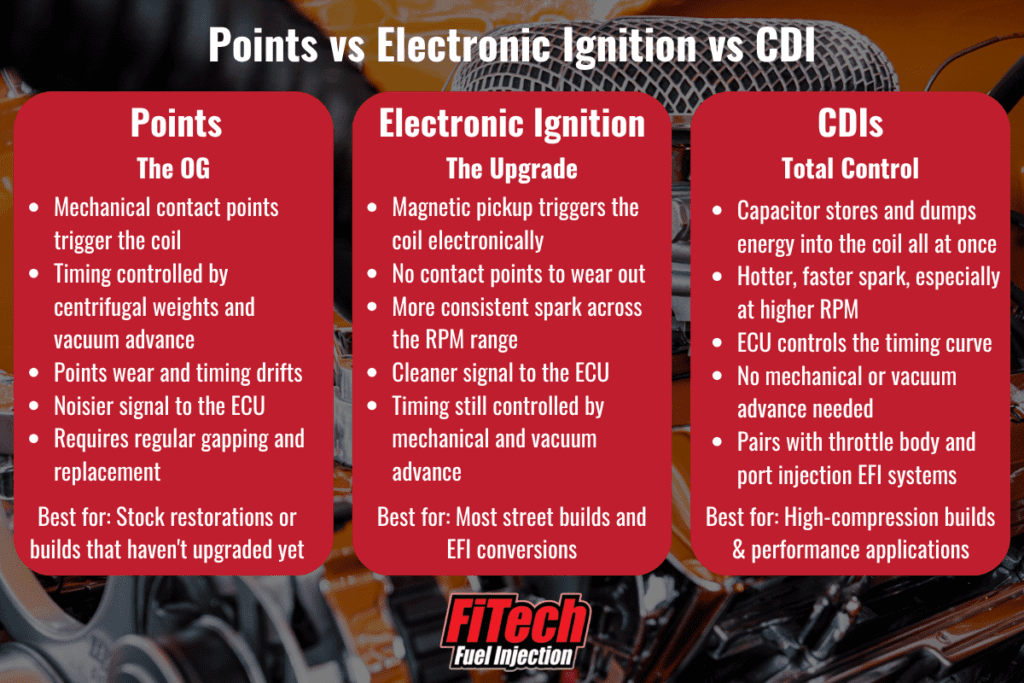
Breaker points are the original ignition system on most classic cars and hot rods. A set of mechanical contact points inside the distributor open and close to trigger the ignition coil. The coil converts battery voltage into the high voltage needed to fire the spark plug, and the distributor cap routes that voltage to each spark plug wire in firing order.
Timing is controlled mechanically:
- Centrifugal weights inside the distributor advance timing as RPM increases
- A vacuum advance canister adjusts timing based on engine load
It’s a simple system that works, but it has limitations:
- Points wear over time and need regular gapping and replacement
- Timing drifts as the points wear, which means the engine gradually falls out of tune
- The mechanical advance curve is fixed by spring tension and weight design, so it’s a compromise that can’t adapt to changing conditions
A lot of classic cars and hot rods are still running points. FiTech EFI will work with a points-based ignition, but the signal to the ECU is noisier and less consistent than what electronic ignition provides.
Electronic Ignition
Electronic ignition replaced breaker points with an ignition module and a magnetic pickup inside the distributor. Instead of mechanical contact points opening and closing, the magnetic pickup generates a signal that triggers the ignition coil electronically.
The benefits over points:
- No contact points to wear out or drift
- More consistent spark across the RPM range
- Less maintenance
- Cleaner signal to the ECU for more reliable EFI operation
Most aftermarket distributors for classic cars come with electronic ignition built in. If your car was built after the mid-1970s, it likely already has electronic ignition from the factory. FiTech’s Go Spark ignition line also offers distributors, coils, and spark plug wires designed to pair with their EFI systems.
Electronic ignition still uses a distributor with mechanical and vacuum advance in most cases. The improvement is in how the coil gets triggered, not how timing is controlled.
Choosing the Right Ignition Components
Why It Matters More With EFI
Your ECU calculates the exact air-fuel mixture your engine needs on every cycle, but if the spark doesn’t fire at the right time or with enough energy, that mixture doesn’t burn efficiently. Weak spark or inconsistent timing wastes the precision your EFI system provides.
Engine misfires, poor throttle response, and reduced fuel economy are often ignition problems misdiagnosed as tuning issues. Before you start adjusting fuel tables, make sure the ignition side is doing its job.
Spark Plugs and Wires
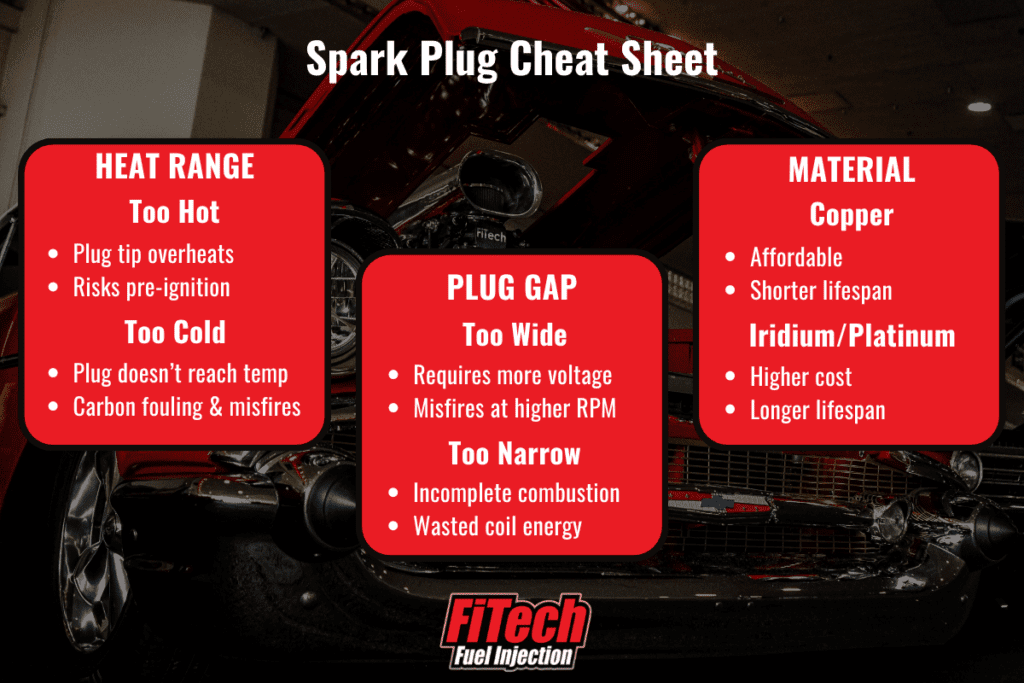
Spark plug selection matters more with EFI than it did with a carburetor. The key specs to get right:
- Heat range: Needs to match your engine’s combustion chamber temperature. Too hot and you risk pre-ignition. Too cold and the plug fouls.
- Gap: Needs to match what your EFI system and ignition coil can support. A wider gap requires more voltage to fire. An incorrect gap distance causes misfires.
- Electrode material: Copper is cheap and works fine for most builds. Iridium and platinum last longer but cost more.
Spark plug wires matter just as much. Their job is to carry high voltage from the coil to each spark plug with minimal resistance. Worn or cheap wires cause problems:
- Crossfire between adjacent cylinders
- Misfires under load
- RFI interference that can affect ECU sensor readings
Quality spark plug wires with low resistance and good insulation keep the spark consistent and the ECU happy.
Ignition Coil
The ignition coil converts battery voltage into the high voltage needed to fire the spark plug. A stock or worn coil may not deliver enough energy for consistent spark, especially at higher RPM where the coil has less time to recharge between firings.
For EFI builds, a hotter coil helps. More spark energy means more complete combustion of the air-fuel mixture in the combustion chamber, which means the ECU’s fuel calculations actually translate to real-world performance.
When choosing a coil, make sure it matches your ignition module and spark plug gap. A coil that’s too weak for a wide gap won’t fire reliably. A coil that’s too hot for a narrow gap wastes energy and can shorten plug life.
ECU-Controlled Timing
Running Timing Through the ECU
A lot of EFI setups run timing through the distributor the same way they always have. Mechanical and vacuum advance handle the timing curve, and the ECU only controls fuel delivery. That works, but the timing curve is a compromise built into springs and weights that can’t adapt to changing conditions.
ECU-controlled timing replaces that with electronic timing maps. The ECU sets timing based on RPM, engine load, and sensor data for every operating point. The result:
- More precise timing at every RPM and load combination
- The ability to pull timing if a knock sensor detects detonation
- No mechanical springs or weights to wear out or drift
- Timing adjustments through the handheld controller instead of recurving a distributor
To run ECU-controlled timing, you need to lock out the distributor’s mechanical and vacuum advance so the ECU has full authority over the timing curve.
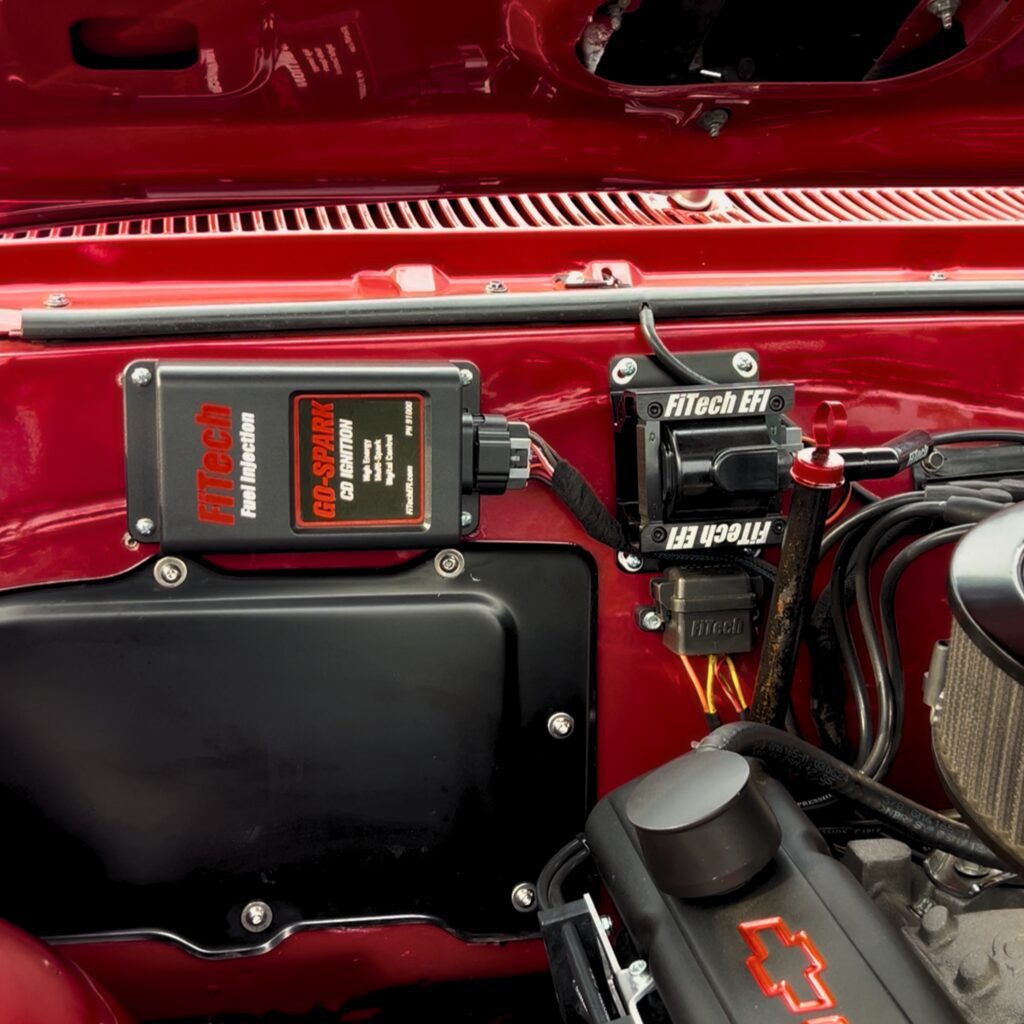
FiTech Go Spark CDI Box
Our Go Spark CDI box pairs ECU-controlled timing with a CDI (capacitive discharge ignition) design. A CDI system stores energy in a capacitor and dumps it into the ignition coil all at once, which delivers a hotter, faster spark than a standard inductive ignition system.
What the Go Spark CDI gives you:
- Full timing control from the ECU, no mechanical or vacuum advance needed
- Hotter spark for more complete combustion, especially at higher RPM
- Compatible with points, electronic ignition, HEI, and magnetic pickup distributors
- Pairs directly with our throttle body and port injection EFI systems
For builders who want fuel and ignition control managed by one system, the Go Spark CDI box ties it all together. It’s especially valuable on high-compression builds, performance applications where timing precision matters, and any setup where you want to eliminate the guesswork of mechanical advance curves.
FiTech Go Spark Ignition Line
We also offer a full line of ignition components designed to pair with our EFI systems:
- Distributors
- Spark plug wires
- Ignition coils
- CDI boxes
All backed by a 3-year warranty. If you’re upgrading your ignition alongside an EFI conversion, sourcing everything from one place ensures the components are designed, matched, and tested together.
Match Your Ignition to Your EFI
Your EFI system is only as good as the spark behind it. The ECU can calculate the perfect air-fuel mixture, but if the ignition system can’t deliver a consistent spark at the right time, you’re leaving performance on the table.
At minimum, make sure you’re running electronic ignition, quality spark plug wires, plugs gapped to match your system, and a coil that can keep up at higher RPM. That covers most street builds and weekend cruisers.
If you want the ECU to control the full timing curve, our Go Spark CDI box handles ignition and fuel management together. Pair it with our Go Spark distributors, coils, and plug wires for a complete ignition upgrade matched to your EFI system.
Check out our full lineup of Go Spark ignition products, throttle body EFI systems, and master kits to find the right setup for your build. Not sure what you need? Give our tech team a call and we’ll help you figure it out.