
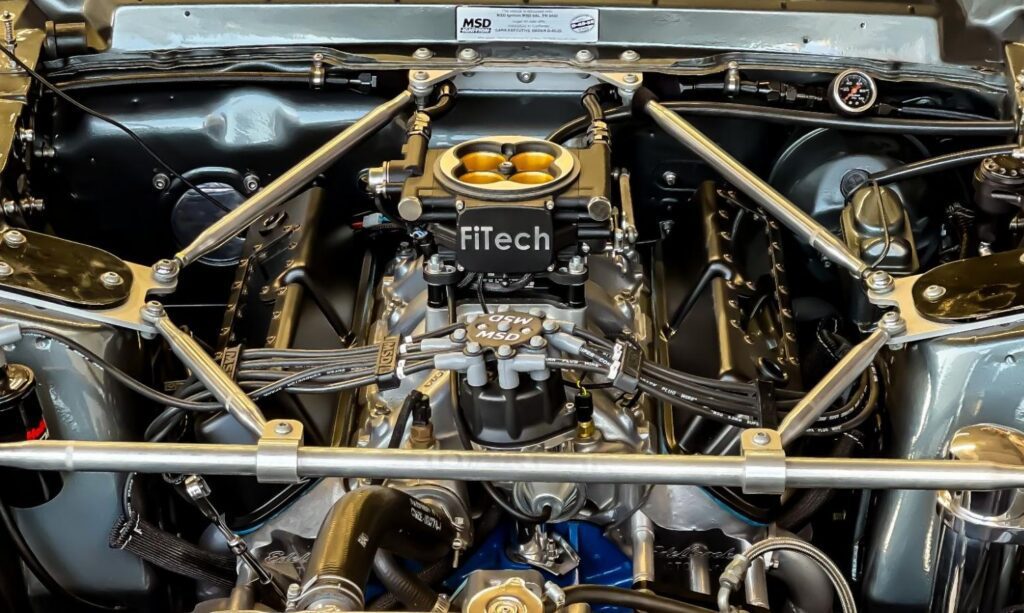
The Short Answer: Drive by cable uses a physical throttle cable to connect the gas pedal to the throttle body. Drive by wire replaces that cable with an electronic signal, using a sensor at the pedal and a motor on the throttle body controlled by the ECU. Both work with EFI, but which one fits your build depends on your engine, your goals, and how much control you want the ECU to have.
If you’re looking into EFI (electronic fuel injection) for your classic car or hot rod, one of the decisions you’ll run into is how the throttle gets controlled. An EFI system replaces the carburetor with electronically controlled fuel injectors managed by an ECU (engine control unit). The ECU handles fuel delivery and, on many systems, ignition timing. But how it communicates with the throttle is a separate question.
Most classic car and hot rod builds use a cable. It’s simple; it’s what every carbureted car used before it, and it works. But drive-by-wire is becoming more common, especially on LS swaps and performance builds where builders want the ECU to manage the throttle directly.
This guide covers how each throttle system works, where each one makes sense, and how to decide which one is right for your build.
How Each System Works
Drive by Cable
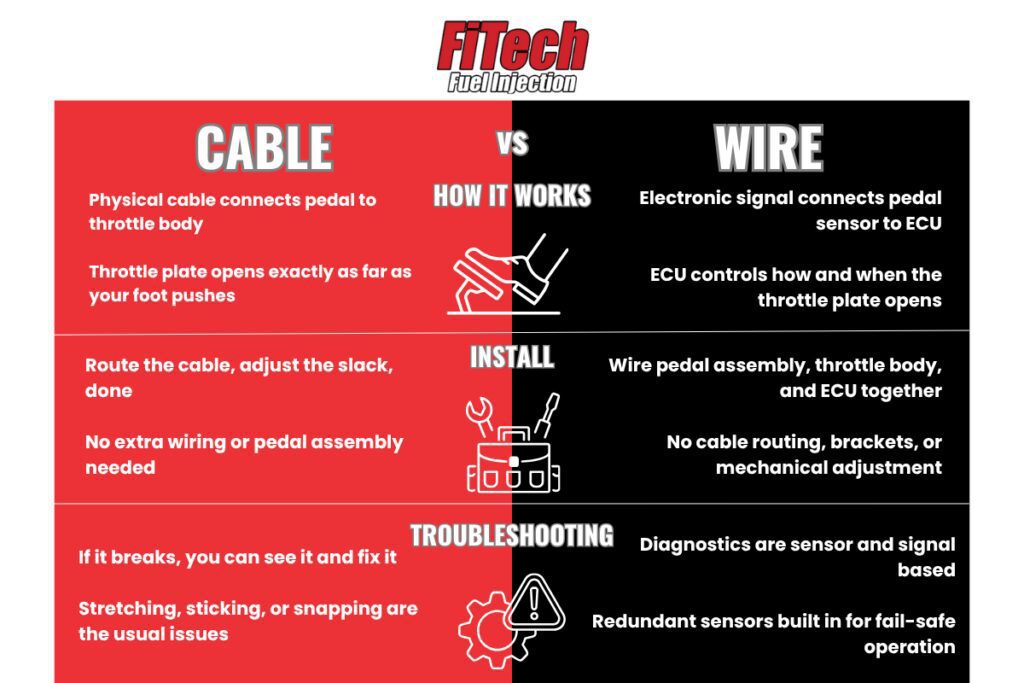
A throttle cable is a direct mechanical connection between the accelerator pedal and the throttle body. When you press the gas pedal, the cable pulls the throttle plate open. Let off the pedal, and a return spring closes it. That’s it.
There’s nothing between your foot and the throttle. The cable is a physical linkage that translates pedal movement into throttle plate movement. On an EFI system, the throttle position sensor reads how far the plate is open and reports that to the ECU, but the cable is what physically moves it.
Cable throttle systems are what every carbureted car used, and they’re still the standard on most classic car and hot rod EFI conversions. No pedal assembly to wire, no throttle controller to configure, and no electronic motor on the throttle body. You route the cable, adjust the slack, and you’re done.
For a walkthrough on setting your throttle cable and adjustment, check out our Tech Tuesday on Throttle Adjustment.
Drive by Wire
A drive-by-wire system removes the physical cable entirely. Instead, a sensor inside the DBW pedal assembly reads how far you’ve pressed the gas pedal and sends an electrical signal to the ECU. The ECU then commands a small motor on the electronic throttle body to open the throttle plate.
Your foot tells the ECU what you want. The ECU decides how to deliver it.
That extra layer of control is the key difference. With a cable, the throttle plate opens exactly as far as your foot pushes. With drive-by-wire, the ECU can shape the throttle response, adjust how quickly the plate opens, and manage the throttle for features like cruise control, traction control, and auto blip on downshifts in manual transmission applications.
SAE International research on drive-by-wire throttle systems found that replacing the mechanical connection with an ECU-controlled demand map gives engineers complete freedom in shaping how the throttle responds to driver input, which is the foundation for the tunable drive modes available on modern DBW systems.
Most vehicles built since the early 2000s use drive-by-wire from the factory. In the aftermarket, it’s most common on LS swap builds where the factory LS engine was already set up for DBW.
Pros and Cons
Why Cable Still Works for Most Classic Builds
A cable throttle system has one job, and it does it well. There’s a direct connection between your foot and the throttle plate, which gives you an unfiltered pedal feel with no electronic interpretation between you and the engine.
The install is straightforward:
- Route the cable from the pedal to the throttle body
- Adjust the slack
- No DBW pedal assembly to wire
- No throttle controller or DBW module to configure
If something goes wrong, you can see it and fix it. A cable stretches, sticks, or breaks. There’s no electrical troubleshooting, no sensor diagnostics, and no software to deal with. For classic cars, hot rods, and most carb-to-EFI conversions, cable is the practical choice. It’s what all of our Go EFI throttle body systems use.
Why Drive by Wire Is Worth Considering
The advantage of a DBW system is that the ECU controls the throttle plate directly. That opens up features a cable setup can’t support:
- Cruise control integration without a separate aftermarket module
- Traction control: the ECU can reduce throttle if it detects wheel spin
- Auto blip on downshifts for manual transmission builds
- Preset drive modes that adjust pedal feel and throttle response for daily driving, towing, or high-performance use
- Cleaner engine bay with no cable routing, brackets, or mechanical linkage
Because the ECU sits between the pedal and the throttle body, it can shape how the throttle opens. A cable gives you a 1:1 relationship between pedal position and throttle plate angle. A DBW system lets the ECU smooth that curve, sharpen it, or adjust it based on driving conditions.
For LS swaps and modern engine builds, drive-by-wire makes sense. Many factory LS engines came with DBW from the factory, so the engine is already set up for electronic throttle control. Our standalone LS DBW systems include preset drive modes that tune the throttle response without touching the fuel calibration.
Which One Is Right for Your Build
Classic Car and Hot Rod EFI Conversions
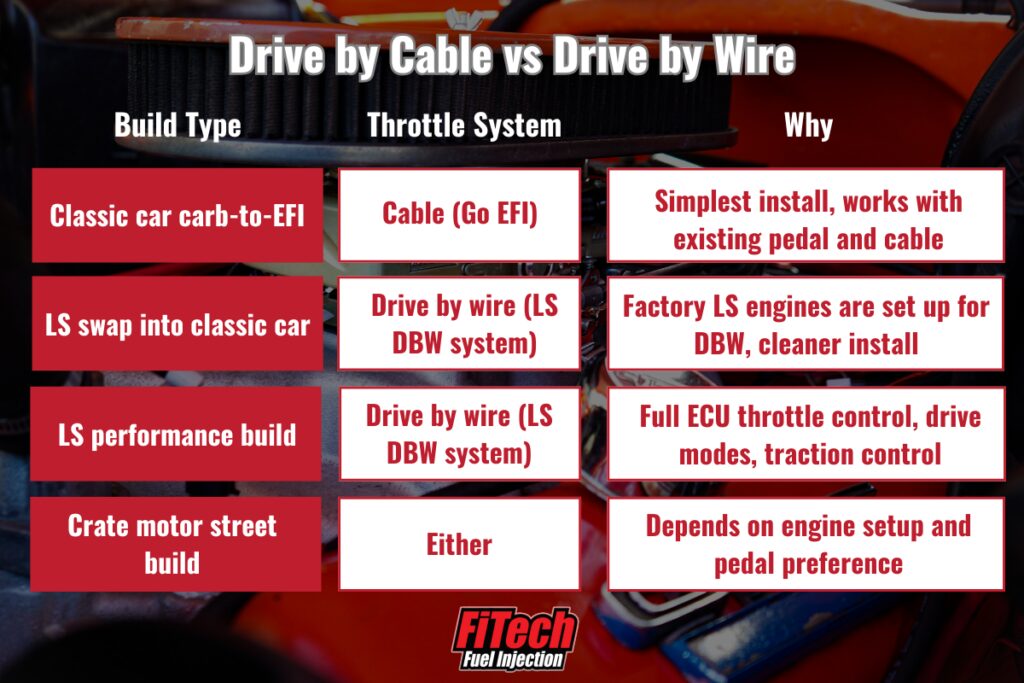
If you’re pulling a carburetor off a classic V8 and bolting on EFI, cable is the way to go. It’s the simplest path with the least amount of additional wiring and configuration.
Our Go EFI throttle body systems all use a cable throttle body. The throttle cable routes from your existing gas pedal to the throttle body the same way it was connected to the carburetor. No DBW pedal assembly, no electronic throttle motor, no additional wiring harness. If your car already has a throttle cable, you’re most of the way there. Not sure which throttle body fits your engine? Watch our Tech Tuesday on Choosing Your Throttle Body.
LS Swaps and Modern Engine Builds
If you’re running an LS engine, drive-by-wire is worth the upgrade. Many factory LS engines came with DBW from the factory, so the engine is already wired for electronic throttle control.
Our LS DBW lineup gives you everything you need:
- Billet drive-by-wire throttle bodies in 92mm and 102mm
- Standalone LS DBW systems with the ECU, wiring harness, sensors, and integrated DBW controller
- Available with or without transmission control
- Preset drive modes for daily driving, towing, and high-performance use
No throttle cable to route, no brackets, no mechanical adjustments. The ECU handles the throttle plate directly for smoother throttle response and a cleaner engine bay.
Cable or Wire: Pick What Fits Your Build
Both systems get the throttle open. A cable does it with a direct mechanical connection between the gas pedal and the throttle body. Drive by wire does it electronically, with the ECU controlling exactly how the throttle plate responds.
For classic car and hot rod EFI conversions, cable is the standard and what our Go EFI throttle body lineup is built around. For LS swaps and modern engine builds, our LS DBW throttle bodies and standalone LS DBW systems give you full electronic throttle control with preset drive modes and a cleaner install.
Check out our full lineup of throttle body EFI systems, LS DBW throttle bodies, and standalone LS DBW systems to find the right setup for your build. Not sure which direction to go?
Give our tech team a call, and we’ll help you figure it out.
Frequently Asked Questions
Can I use a cable throttle body with a FiTech EFI system?
Yes. All of our Go EFI throttle body systems use a cable throttle connection. The cable routes from your gas pedal to the throttle body the same way it connected to your carburetor.
Do I need a special pedal for drive-by-wire?
Yes. A DBW system requires a pedal assembly with a built-in position sensor that sends an electrical signal to the ECU. Your existing mechanical gas pedal and throttle cable won’t work with a drive-by-wire throttle body.
Can I convert a cable throttle body to drive-by-wire?
No. A cable throttle body and a DBW throttle body are different units. A cable throttle body uses a mechanical linkage to open the throttle plate. A DBW throttle body has an electronic motor controlled by the ECU. They’re not interchangeable. For more on this, watch our FAQ Swap Series on running a cable TB with a DBW engine.
Is drive-by-wire faster than cable?
Not necessarily in terms of raw throttle opening speed. The advantage of DBW is that the ECU can shape the throttle curve, smooth out abrupt inputs, and manage features like traction control and cruise control. Some builders feel cable gives a more direct pedal feel. Others prefer the tunable response of DBW.
Does FiTech offer drive-by-wire systems?
Yes. We offer LS billet drive-by-wire throttle bodies in 92mm and 102mm, and standalone LS DBW systems with and without transmission control. These are designed for LS-powered builds where electronic throttle control is the goal.