
The Short Answer: Both work. A carburetor is a device that’s simple, affordable, and easy to work on. EFI delivers better fuel economy, more consistent cold starts, and automatic fuel corrections that a carburetor can’t match. The right choice depends on your build, how you drive it, and what matters most to you.
This is the debate that never dies in the classic car and hot rod world, and both sides have valid points. A well-tuned carburetor can run great, but a carb setup is only tuned for one set of conditions. Change the altitude, the temperature, or the fuel quality, and that tune is off. EFIs, on the other hand, adjust for all of it automatically.
That doesn’t mean a carburetor is the wrong choice for every build. It means the right choice depends on how you use the car, what problems you’re willing to live with, and what you want out of the driving experience. This guide compares carburetors and EFI on the things that actually matter for a street-driven classic: driveability, fuel economy, cold starts, maintenance, and install complexity.
How They Work
How a Carburetor Works
A carburetor is a mechanical device that mixes air and fuel using vacuum and jets. As air flows through the venturi, it creates a pressure drop that draws fuel from a float bowl through the calibrated jets. An accelerator pump provides extra fuel on tip-in, and idle speed is set with a screw that controls airflow at rest. Tuning means changing jets, adjusting float levels, and setting mixture screws on the carb intake. No electronics, no sensors, no wiring.
How EFI Works
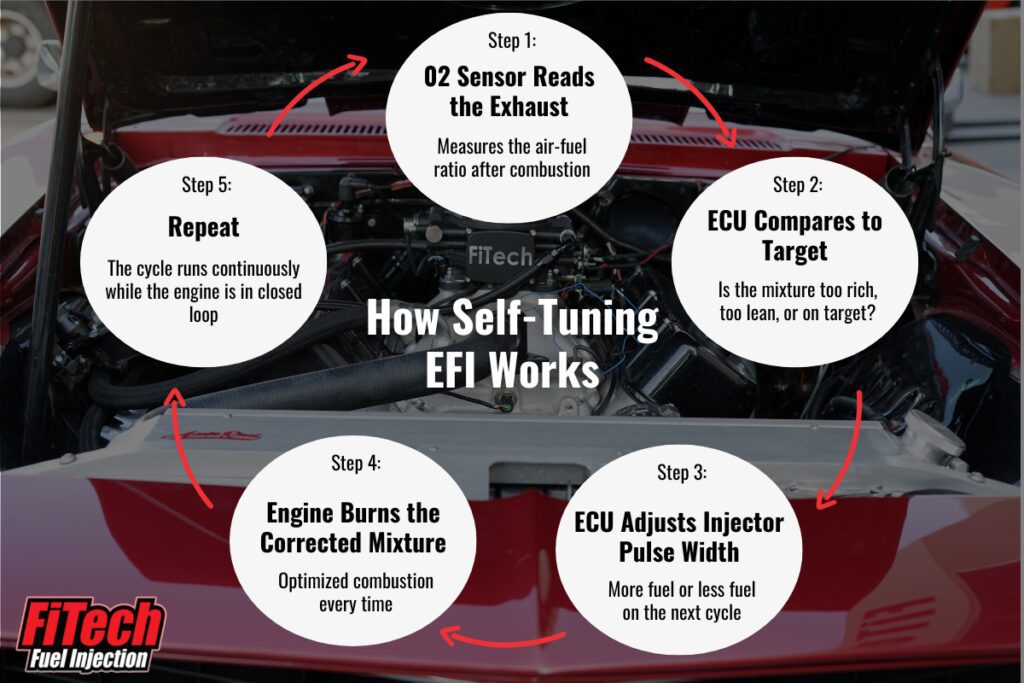
Electronic fuel injection replaces that with a sensor-driven system. An ECU reads throttle position, manifold pressure, coolant temperature, and exhaust oxygen content, then controls fuel injectors that deliver a precise air-fuel mixture on every cycle.
A high-pressure electric fuel pump delivers fuel from the fuel tank at around 58 PSI, and the ECU controls injector pulse width to determine exactly how much fuel flow enters the combustion chamber at any given moment. Additionally, self-tuning systems use a wideband O₂ sensor to adjust fueling in real time, adapting to your engine, altitude, temperature, and fuel quality without you touching anything.
For a deeper breakdown, check out our full guide: What Is an EFI?
Where EFI Wins
Cold Starts and Cold Weather
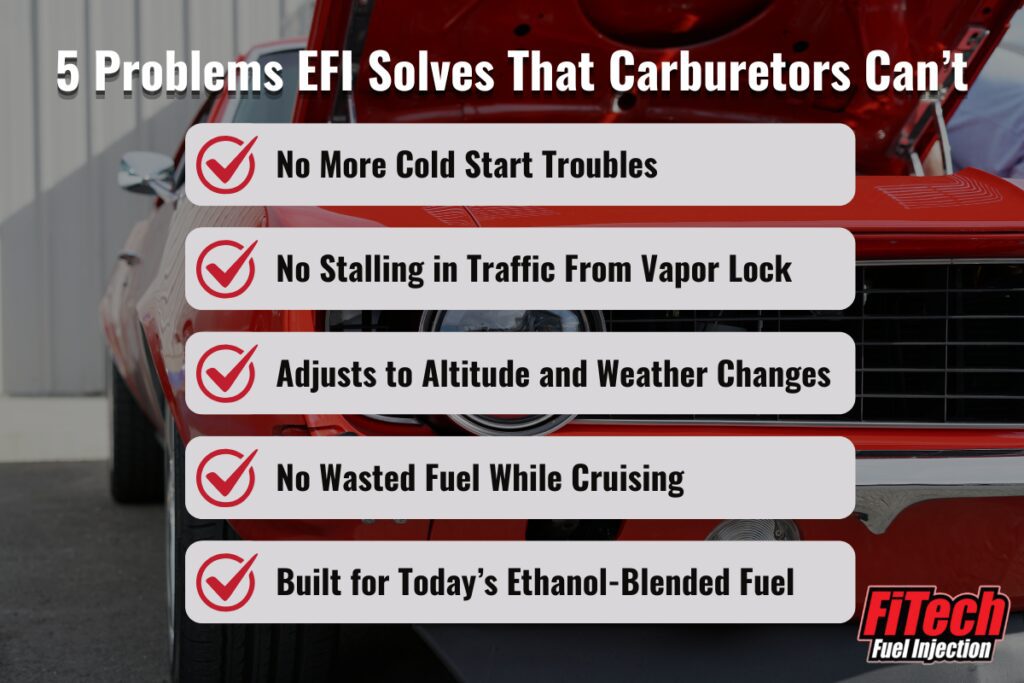
This is where the gap between carburetors and EFI is the widest. A carbed engine relies on a choke and careful jetting to deliver the right fuel mixture when the engine is cold. If the choke isn’t set right, you’re pumping the accelerator, flooding the engine, or waiting for it to stumble its way to operating temperature.
EFI handles cold starts automatically. The coolant temperature sensor tells the ECU the engine is cold, and the ECU adds extra fuel to compensate. As the engine warms up, it tapers the enrichment back to normal. No choke. No pumping. No flooding. Just turn the key and drive.
If you live in a colder climate or your classic sits for weeks between drives, this alone is a significant upgrade over a carburetor.
Fuel Economy
A carburetor delivers the same amount of fuel based on jet size and vacuum signal regardless of conditions. It can’t adjust for changes in temperature, altitude, or fuel quality. That means it’s usually running richer than it needs to at cruise just to compensate across all conditions.
A fuel injection system leans the mixture at cruise for better fuel economy and enriches under load for power. Closed-loop correction keeps the air-fuel ratio optimized in real time. According to the U.S. Department of Energy, a malfunctioning oxygen sensor alone can reduce fuel economy by as much as 40%, which shows how much efficiency depends on the kind of real-time correction that only EFI provides.
For daily drivers and long-distance cruisers, the improvement in fuel consumption adds up in the long run.
Throttle Response and Driveability
A carbed engine can run great when it’s perfectly tuned. The problem is that tune only works under the exact conditions it was set for. Change the altitude, the weather, or the fuel, and the carburetor can’t compensate. You get flat spots, hesitation, or a rich condition that wasn’t there last week.
EFI adjusts fueling in milliseconds based on throttle position and engine load, from idle all the way to full throttle. No bog on tip-in. No flat spots from a mis-jetted transition circuit. SAE International research has shown that EFI systems deliver significantly more consistent fuel delivery and better engine performance than carbureted systems, which translates directly to smoother drivability on the street and reduced emissions in some cases.
Self-tuning systems go further by adapting to your engine over time. Drive it from sea level to the mountains, and the ECU corrects automatically. A carburetor can’t do that without a jet change, and if it’s oversized for the engine, it overfuels. An EFI system self-tunes across the entire horsepower range your engine produces.
Less Time Under the Hood
A carburetor needs regular attention. Gaskets wear, floats stick, jets clog, and when performance drops, you’re buying a rebuild kit and spending an afternoon tearing it down. Even after a fresh kit, the carb doesn’t always come back running right.
EFI doesn’t have that cycle. There are no jets to clog, no floats to stick, and no rebuild kits to buy. The system self-tunes, and the components rarely need service. You spend your time driving, not maintaining.
Why Some Builders Stick With Carburetors
Simplicity and Cost
A carburetor has no wiring harness, no sensors, and no ECU. If something goes wrong, you can diagnose it with a screwdriver and a vacuum gauge. There’s no sensor failure to chase, no electrical troubleshooting, and no handheld controller to learn. It’s a mechanical device you can see, touch, and adjust with hand tools.
A quality four-barrel carburetor is also less expensive upfront than a full EFI system. Your stock mechanical fuel pump works fine, your existing low-pressure fuel lines stay in place, and there are no fuel system upgrades to budget for. For a budget build or a show car that comes out a few times a year, the cost difference is hard to ignore. If you’re driving the car regularly, though, EFI makes that cost back over time through better fuel economy, fewer rebuilds, and less time spent chasing jetting and tuning issues.
Personal Preference
Some racing classes require carburetors. Some builders just prefer them. If you like the sound of secondaries opening, the ritual of jetting for a weekend cruise, and the satisfaction of dialing in a carb setup by feel, EFI isn’t going to replace that experience. Personal preference is a legitimate reason. Both approaches get fuel into the engine. How you want to get there is up to you.
Making the Switch
What an EFI Conversion Involves
If you’re coming from a carburetor, our throttle body EFI system is the most straightforward conversion. The throttle body bolts onto your existing four-barrel intake manifold, right where the carb sat. Beyond that, you’ll need a wiring harness, O₂ sensor, coolant temp sensor, and a fuel delivery solution that supports 58 PSI. All of these come included with our Go EFI systems, and our master kits bundle the EFI and fuel delivery together so you’re not sourcing anything separately.
Our Force Fuel system works with your stock fuel tank and supply line. Go Fuel in-tank modules give you a cleaner, returnless setup. The self-tuning ECU handles calibration with no laptop, no dyno, and no tuner. For most builds, it’s a weekend project.
Is It Worth It?
That depends on how you use the car.
- If you drive your classic daily, EFI pays for itself in drivability, fuel economy, and cold-start reliability
- If you’re tired of chasing carb issues, re-jetting for different conditions, or fighting vapor lock in traffic, EFI solves those problems
- If your car lives in a garage and comes out for shows a few times a year, a carburetor can work just fine
But if drivability and consistency matter to you, EFI is the upgrade that delivers both.
Which One Is Right for Your Build?
Both carburetors and EFI get fuel into the engine. A carburetor does it mechanically with simplicity, low cost, and hands-on tuning. A fuel injection system does it electronically with real-time correction, automatic cold starts, and better fuel economy across every driving condition.
If you want the benefits of EFI on your classic car or hot rod, we make the conversion straightforward. Our throttle body EFI systems bolt onto your existing intake, self-tune out of the box, and pair with fuel delivery options that work with your stock tank or upgrade it. Check out our full lineup of throttle body EFI systems, fuel delivery kits, and master kits to find the right setup for your build.
Not sure where to start? Give our tech team a call at (951) 340-2624, and we’ll help you figure it out.
Frequently Asked Questions
Can I convert my carbureted engine to EFI without modifying the intake manifold?
Yes. Throttle body EFI systems like our Go EFI bolt directly onto any standard four-barrel intake manifold, right where the carburetor sat. No intake swap or modification required.
Will EFI make more horsepower than a carburetor?
Not necessarily. A properly sized carburetor and a throttle body EFI system will support similar peak horsepower on the same engine. The difference is in how consistently the fuel is delivered. EFI maintains the correct air-fuel ratio across all conditions, which means the engine runs closer to its best performance more of the time.
Do I need to upgrade my fuel system for EFI?
Yes. A stock mechanical fuel pump and low-pressure fuel lines can’t support the 58 PSI that EFI requires. You’ll need a high-pressure electric fuel pump, EFI-rated lines, and proper filtration. Our Force Fuel system, Go Fuel in-tank modules, and master kits are all designed to handle this.
Is EFI harder to install than a carburetor?
It’s more involved, but not difficult. A throttle body EFI system bolts on in the same spot as the carburetor. The additional work is wiring the harness, installing the O₂ sensor and coolant temp sensor, and setting up fuel delivery. For most builds, it’s a weekend project.
Can I switch back to a carburetor after installing EFI?
Yes. A throttle body EFI system doesn’t require permanent modifications to the engine or intake manifold. If you wanted to go back to a carburetor, you would just need to swap the fuel delivery system back to low-pressure components.
Does EFI work with modern ethanol-blended fuel better than a carburetor?
EFI handles ethanol-blended fuel more effectively because the ECU adjusts the air-fuel ratio in real time based on O₂ sensor feedback. Carburetors can’t compensate for the leaner burn characteristics of ethanol without re-jetting, and the ethanol can corrode rubber seals, float bowl gaskets, and brass components in older carburetors over time.