The Short Answer: An EFI fuel system needs to deliver fuel at higher pressure and more consistent flow than a carburetor setup. At minimum, you need an electric fuel pump capable of ~58 PSI, EFI-rated fuel lines, a fuel pressure regulator, proper filtration, and a fuel tank that can support the system.
If you just attached a throttle body EFI system, or you’re planning to, the fuel side of the equation is where most people hit a wall. Your stock mechanical fuel pump, rubber fuel lines, and low-pressure setup were designed for a carburetor pulling 4–7 PSI. An EFI system demands roughly ten times that pressure, delivered consistently, clean fuel, and no air in the line.
The good news is you don’t have to gut your entire fuel system to make it work. Depending on your setup, you may be able to keep your stock fuel tank and supply line, but you do need the right pump, the right plumbing, and the right filtration to keep fuel pressure steady and your injectors happy.
This guide covers what your EFI fuel system needs, why each component matters, and how to set it up without overcomplicating the install.
Why Your Stock Fuel System Won’t Work for EFI
A carburetor and an EFI system have completely different fuel delivery demands. Swapping a throttle body onto your intake manifold is the easy part. If the fuel system behind it can’t keep up, you’ll end up with poor idle, hesitation, and lean conditions that no amount of tuning will fix. Worst-case scenario, your vehicle won’t be able to start at all!
Pressure: Carb vs. EFI Demands
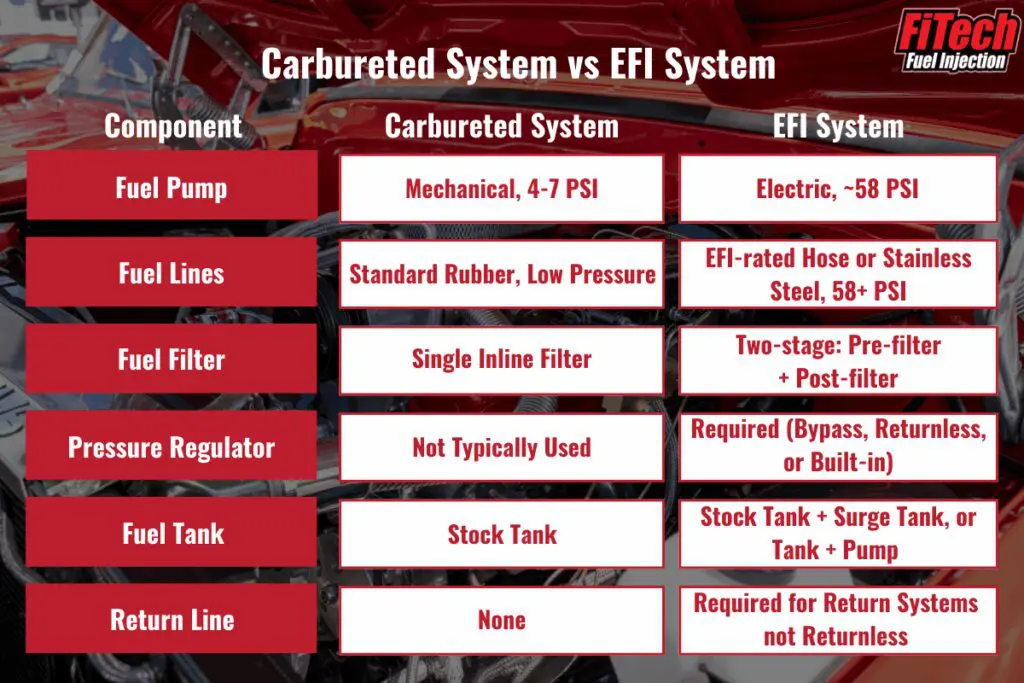
A typical carburetor runs on 4 to 7 PSI of fuel pressure. That’s all it takes to fill a float bowl and let the venturi do its job. Your stock mechanical fuel pump was built to deliver exactly that.
An EFI system needs around 58 PSI. The fuel injectors require high, consistent pressure to atomize fuel properly and deliver precise amounts into the intake or combustion chamber. A mechanical fuel pump physically cannot produce that kind of pressure. Even most low-pressure electric fuel pumps designed for carbureted applications fall short.
If fuel pressure drops below what the ECU expects, the injectors can’t deliver the correct amount of fuel. The engine runs lean, throttle response suffers, and you’ll chase driveability problems that have nothing to do with your tune.
Flow: Feeding Fuel Injectors vs. a Float Bowl
Pressure is only half of the equation. Your fuel system also needs to move enough volume to keep up with demand.
A carburetor fills a float bowl and draws from it as needed. The flow rate doesn’t have to be instant because the bowl acts as a reservoir. A fuel injector doesn’t have that buffer. It fires on command, and if the fuel rail pressure drops because the pump can’t keep up, you get fuel starvation.
This is especially common with:
- High-horsepower builds that demand more fuel at wide-open throttle
- Hot weather driving where heat soak raises fuel temperatures and increases vapor lock risk
- Stock fuel tanks with no baffling, where hard cornering or low fuel levels can uncover the pickup and starve the pump
The fix isn’t complicated, but it does require matching your fuel pump’s flow rate and pressure output to your engine’s demands. A properly sized electric fuel pump, clean filtration, and the right plumbing will handle the job.
Key Components of an EFI Fuel System
Every EFI fuel system has the same core job: deliver clean, high-pressure fuel to the injectors at a consistent flow rate. The components below work together to make that happen. Skip one or cheap out on another, and the whole system suffers.
Fuel Pump: Electric, In-Tank, or External
Your fuel pump is the heart of the system. For EFI, you need an electric fuel pump rated for the pressure and flow your engine requires. A stock mechanical pump is not an option.
There are two main mounting styles:
An in-tank pump sits inside the fuel tank, submerged in fuel. The fuel keeps the pump cool, which extends pump life and reduces noise. In-tank setups are clean and keep the engine bay free of extra hardware. The downside is that installation requires dropping the tank or cutting an access hole, and if the pump fails, you’re pulling the tank to replace it.
An external pump mounts outside the tank, usually along the frame rail or in the engine bay. External pumps are easier to access and replace, but they run hotter because they aren’t submerged in fuel. They can also be louder. For classic cars and hot rods where cutting into a stock tank isn’t ideal, an external pump or a surge tank setup is often the better path.
What matters most is that the pump can deliver enough flow at the required pressure. For most FiTech systems, that means 58 PSI with a flow rate of at least 255 LPH (liters per hour) for engines up to 600 HP, or a 340lph pump @60PSI, this will allow you to go up to 800hp-1000hp.
Fuel Pressure Regulator
A fuel pressure regulator keeps the fuel pressure at a steady, consistent level regardless of engine load or RPM changes.
Most EFI regulators use a bypass valve design. Fuel enters the regulator, and whatever the injectors don’t use gets routed back to the fuel tank through a return line. This keeps pressure stable and prevents excess fuel from building up in the fuel rail.
In a returnless system, the regulator is built into the fuel pump module or located near the tank. There’s no return line running from the engine back to the tank, which simplifies plumbing and reduces the amount of fuel hose in the engine bay.
Some throttle body systems have a built-in fuel pressure regulator right on the unit, which eliminates the need for a separate external regulator entirely.
Fuel Lines and Fittings
EFI fuel pressure will destroy standard low-pressure rubber fuel lines. You need fuel hose and fittings rated for at least 58 PSI, and ideally higher for a safety margin.
Your options:
- EFI-rated fuel hose with proper AN fittings. This is the most common approach for classic car and hot rod builds. FiTech supplies EFI-grade fuel hose in their master kits.
- Stainless steel hard lines for a cleaner, more permanent installation. These look good and hold up well, but take more time to bend and route.
- Never use aluminum fuel lines. They can crack under EFI pressure, and FiTech specifically warns against them.
Standard hose clamps are not rated for EFI pressures. Use the proper AN fittings or EFI-rated crimp fittings to avoid leaks. At 58 PSI, a loose connection isn’t just a drip. It’s a safety issue.
Fuel Filter
Clean fuel is the single best thing you can do for injector life. Fuel injectors have tiny orifices that clog easily, and debris in the fuel supply can cause misfires, lean spots, and poor idle quality.
A good EFI fuel system uses two stages of filtration:
- A pre-filter (typically 60 to 100 micron) before the fuel pump. This catches larger debris and protects the pump itself.
- A post-filter (typically 10 to 30 micron) after the pump and before the fuel rail. This catches fine particles that would damage or clog the injectors.
If you’re building your fuel system from individual components, don’t skip the filtration. Replacing a clogged filter is cheap. Replacing a set of fouled injectors is not.
Fuel Tank: Stock Tank vs. EFI Tank
The question most builders ask first: can I keep my stock tank?
In many cases, yes. If your stock tank is in good condition, clean inside, and has a usable pickup location, you can often make it work with the right pump and plumbing.
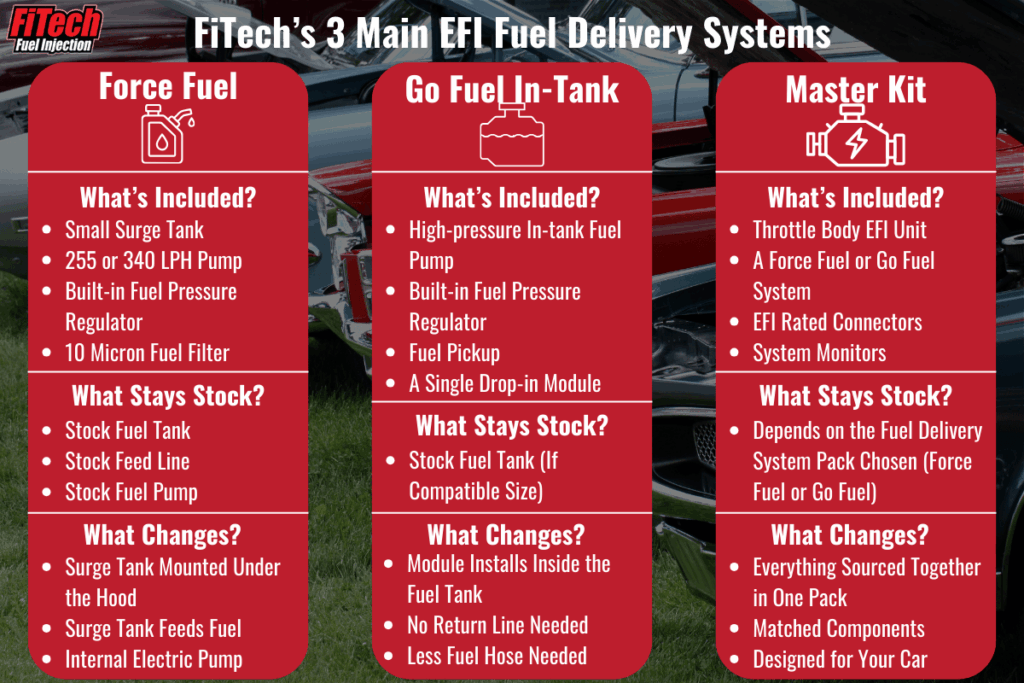
FiTech’s Force Fuel system is designed specifically for this scenario. It uses a small surge tank that your stock fuel pump feeds, and an internal high-pressure electric pump delivers 58 PSI to the throttle body. No need to modify the main tank.
It also works great for dual tank vehicles! Our Force Fuel System lets you keep the stock/factory gas tank switching system and return plumbing while still working flawlessly.
If you want a cleaner setup or your stock tank is in rough shape, an EFI-ready tank or an in-tank fuel pump module is the way to go. A fuel pump module drops into the tank and gives you a high-pressure pump, built-in regulator, and pickup all in one unit. FiTech’s Go Fuel in-tank modules are designed to fit most common tank sizes and eliminate the need for a return line.
If you are running a return-style system, you’ll need a return line bung welded or installed in the tank so excess fuel can flow back.
FiTech Fuel Delivery Solutions
You can piece together an EFI fuel system from individual components, but matching the right pump, regulator, lines, filters, and fittings on your own takes time and leaves room for compatibility issues.
Force Fuel System: Keep Your Stock Setup
The Force Fuel system is built for classic car and hot rod owners who want to convert to EFI without overhauling their entire fuel system.
It works with your existing mechanical or electric fuel pump. Your stock pump feeds fuel into a small surge tank mounted under the hood. Inside that tank, a 340 LPH high-pressure electric pump and internal regulator deliver a consistent 58 PSI to the throttle body.
That means:
- No new feed line from the tank
- No in-tank pump installation
- No return line required
- Your stock fuel tank and supply line stay in place
The main surge tank holds a half gallon of fuel, keeping the internal pump submerged for cooling and preventing fuel starvation during hard driving or low fuel conditions. A serviceable 10-micron fuel filter is included to protect your injectors. The Force Fuel 50004, 50005, & the 50006 Force Fuel Mini hold less fuel as additional options for your build.
If you want the benefits of EFI without cutting into your gas tank or running all new plumbing, the Force Fuel is the simplest path from carburetor to fuel injection. (It is important to consider the horsepower range to determine the ideal Force Fuel System for your vehicle.)
Go Fuel In-Tank Modules: Returnless and Clean
For builders who want a cleaner, more permanent fuel delivery setup, FiTech’s Go Fuel in-tank pump modules are a direct drop-in solution.
These modules install inside your fuel tank and combine a high-pressure fuel pump, built-in regulator, and fuel pickup into a single unit. Because the regulator is at the tank, there’s no return line to run back from the engine. That means less fuel hose in the engine bay and a simpler overall install.
Go Fuel modules are designed to fit most common tank sizes and work with FiTech’s throttle body and port injection EFI systems. They’re a good fit if you’re building a new tank setup from scratch or replacing a worn-out stock tank.
Master Kits: Everything in One Box
If you don’t want to source individual components, FiTech’s master kits bundle the EFI system and fuel delivery together. Depending on the kit, you get:
- Throttle body EFI unit with ECU
- Force Fuel system or Go Fuel in-tank module
- EFI-rated fuel hose, AN fittings, and filters
- O2 sensor, coolant temp sensor, and wiring harness
Everything is matched and tested to work together. No guessing on pump flow rates, line sizes, or regulator compatibility. Pick the kit that matches your engine and horsepower range and you’re covered.
Get Your Fuel System Right the First Time
Your EFI system is only as good as the fuel delivery behind it. The throttle body and ECU can be perfect, but if your fuel pump can’t hold pressure, your lines aren’t rated for the job, or your filtration is missing a stage, you’ll fight driveability issues from day one.
The requirements aren’t complicated. An electric fuel pump that delivers 58 PSI at the flow rate your engine needs. EFI-rated fuel lines and fittings. Two-stage filtration. A fuel pressure regulator, whether it’s built into the throttle body, mounted externally, or integrated into an in-tank module. And a fuel tank setup that keeps the pump fed without starving under hard driving or low fuel conditions.
FiTech builds fuel delivery systems specifically for this. Whether you keep your stock tank with a Force Fuel setup, drop in a Go Fuel in-tank module, or grab a master kit with everything included, the fuel side of your EFI conversion doesn’t have to be the hard part. Match the system to your build, install it right, and let the ECU do the rest.
 Article reviewed 03/09/2026:
 Fred Najera is the Tech Support Manager at FiTech Fuel Injection, bringing years of hands-on experience in the automotive industry. A lifelong car enthusiast, Fred has spent his career working with performance vehicles and helping enthusiasts get the most out of their builds. At FiTech, he leads the technical support team, assisting customers with installation, troubleshooting, and tuning to ensure their EFI systems perform as intended.
See more