
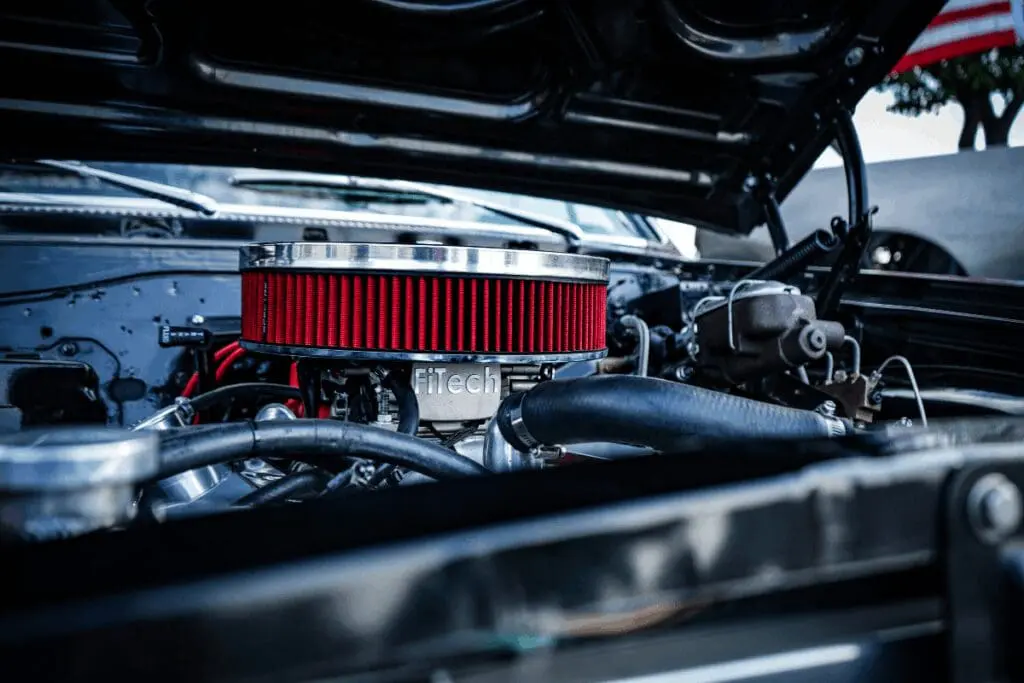
The Short Answer: Electronic fuel injection (EFI) is a fuel delivery system that uses sensors, an engine control unit (ECU), and fuel injectors to meter the exact amount of fuel your engine needs at any given moment. EFI systems read real-time data from your engine and adjust the air/fuel ratio automatically. The result is better cold starts, smoother idle, improved throttle response, and more consistent fuel consumption across every driving condition.
If your classic car or hot rod still runs a carburetor, you already know the routine. Cold starts that take forever. Hot restarts that flood. Idle quality that changes with the weather. You spend more time tuning than driving.
For classic car and hot rod owners, EFI isn’t just a modern upgrade. It’s a practical fix for the problems carburetors have always had. Unlike a carburetor that relies on vacuum and jets, an EFI system does the thinking for you. It reads what your engine needs and delivers fuel accordingly. No constant re-jetting, no choke adjustments, and with self-tuning throttle body systems from companies like FiTech, the swap is simpler than most people expect. Just bolt it on your existing four-barrel intake manifold and drive.
This guide breaks down what EFI is, how it works, how it compares to a carburetor, and whether an electronic fuel injection conversion makes sense for your build.
How Electronic Fuel Injection Works
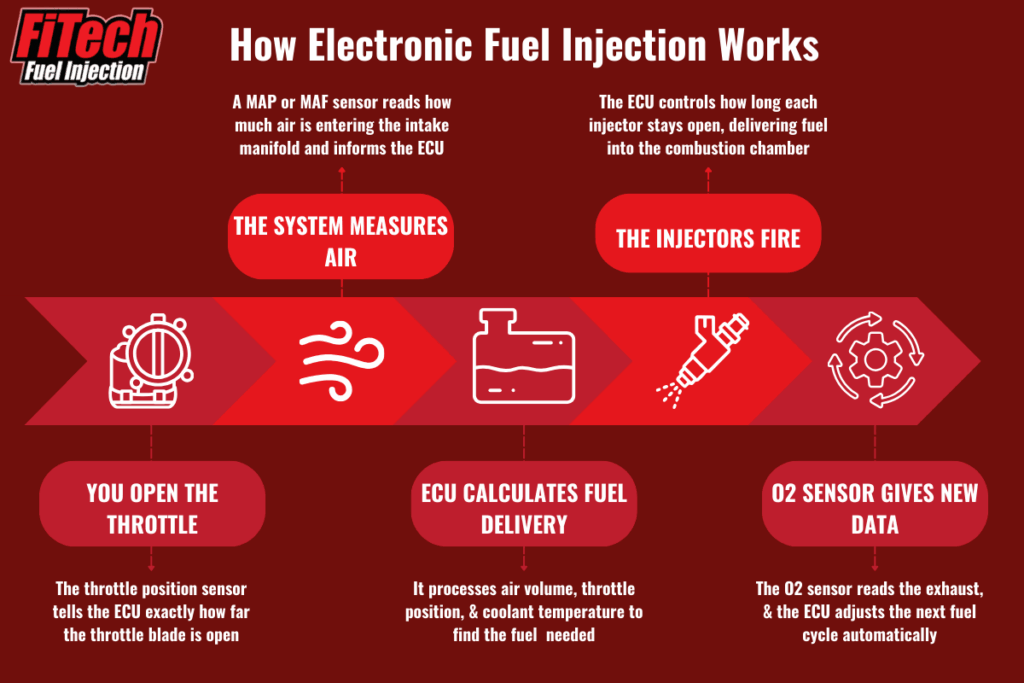
At its core, an EFI system replaces the carburetor’s mechanical approach to fuel delivery with a sensor-driven one. Instead of relying on air velocity through a venturi to draw fuel into the engine, EFI uses an engine control unit (ECU) to calculate exactly how much fuel each injector should deliver and when.
The ECU is the brain of the system. It takes input from several sensors and makes real-time adjustments to fuel delivery and, in many cases, ignition timing. Here’s what’s happening under the hood:
- A manifold absolute pressure (MAP) sensor or mass airflow (MAF) sensor measures how much air is entering the intake manifold.
- A throttle position sensor (TPS) tells the ECU how far the throttle valve is open.
- A coolant temperature sensor adjusts the fuel mixture for cold starts and warm-up.
- An oxygen (O2) sensor in the exhaust reads the air/fuel ratio after combustion and feeds that data back to the ECU for continuous correction.
The ECU processes all of this data in milliseconds. It then controls the pulse width of each fuel injector, which determines how long the injector stays open and how much fuel enters the combustion chamber per cycle. More throttle, more air, more fuel. Less throttle, less fuel. All automatic.
Throttle Body Injection vs. Port Injection vs. Direct Injection
Not all fuel injection systems work the same way. The three main types differ in where and how fuel is introduced into the engine.
Throttle Body Injection (TBI)
TBI places the fuel injectors in a centralized throttle body unit that sits on top of the intake manifold, right where a carburetor would go. Fuel is sprayed above the manifold and distributed to each cylinder through the intake runners.
This is the most common style for classic car and hot rod EFI conversions because it bolts directly onto an existing four-barrel intake manifold with minimal modification.
Port Injection
Port injection (also called multi-point fuel injection) places an individual injector at each intake port, just ahead of the intake valve. This allows more precise fuel delivery per cylinder and is the standard setup on most factory vehicles from the late 1980s through the 2000s.
FiTech offers port injection systems as well, including their Go Port EFI and Ultra Ram lines for small block and big block Chevys.
Direct Injection
Direct injection places the injector inside the combustion chamber itself, spraying fuel directly onto the piston or into the cylinder. This is the most precise method and is common on modern engines, but it requires high fuel pressure and specialized cylinder head design. It’s not a practical retrofit for classic builds.
| Type | Injector Location | Common Use | Retrofit Friendly? |
|---|---|---|---|
| Throttle Body (TBI) | Top of the intake manifold | Classic cars, hot rods, street rods | Yes — bolts onto 4-barrel intake |
| Port Injection | Individual intake ports | Factory vehicles (late ’80s–2000s) | Limited — requires a dedicated intake manifold and fuel rails |
| Direct Injection | Inside the combustion chamber | Modern factory engines (2010+) | No — requires specialized heads and a high-pressure fuel system |
For most classic car and hot rod owners, a self-tuning throttle body EFI system is the practical choice. It gives you the benefits of electronic fuel injection without tearing apart your existing engine setup.
EFI vs. Carburetors: Why Owners Are Making the Switch
Carburetors have been around for over a century, and they work, but “works” and “works well in every condition” are two different things. For classic car and hot rod owners who actually want to drive their builds, electronic fuel injection solves the problems that carburetors can’t.
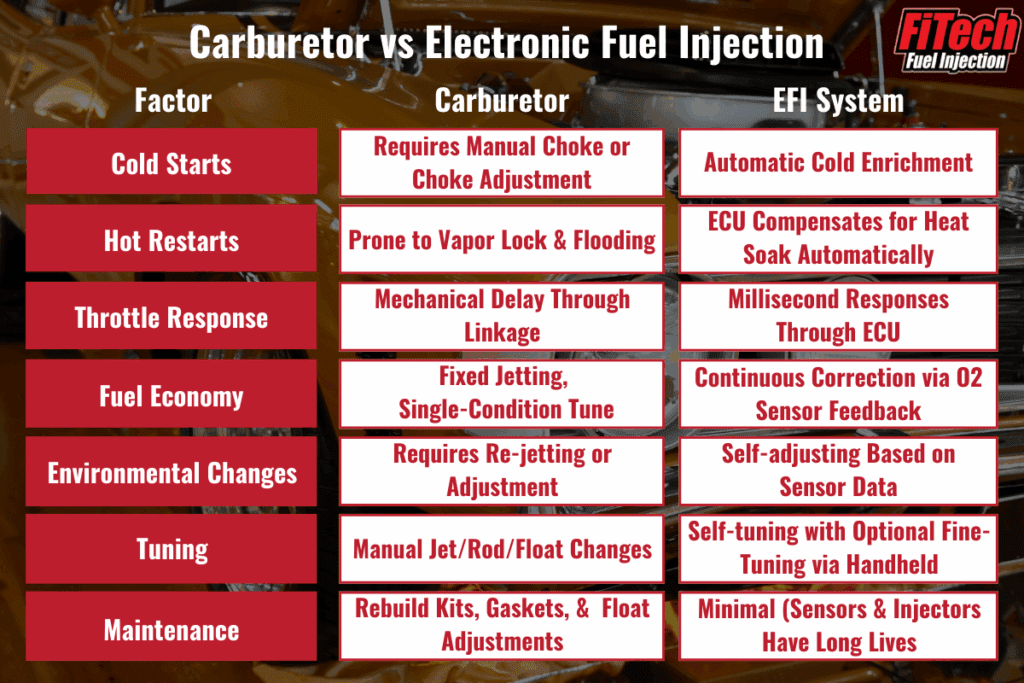
Cold Starts & Hot Restarts
This is where most carb frustration starts.
With a carburetor, cold starts depend on a choke to richen the fuel mixture. If the choke isn’t set right, you’re cranking, pumping, and flooding. Hot restarts can be just as bad. Heat soak causes fuel to vaporize in the float bowl, and you’re sitting in a parking lot waiting for things to cool down.
With EFI, none of that applies. The coolant temperature sensor tells the ECU what’s going on, and the system adjusts fuel delivery instantly.
- Cold morning? The injectors add fuel automatically.
- Hot restart after sitting in the sun? The ECU compensates.
- No pumping, no flooding, no fighting it.
Throttle Response
Throttle response is the other big difference maker. A carburetor has a mechanical delay between your foot and the fuel. An EFI system reacts in milliseconds. You hit the gas, and the engine responds. That kind of predictability matters whether you’re merging onto the highway in a weekend cruiser or staging a bracket car.
Fuel Consumption and Tuning
A carburetor delivers fuel based on a fixed set of jets and metering rods. It’s a compromise tuned for one set of conditions. Change the altitude, temperature, or humidity, and that tune shifts. You’re either running rich and wasting fuel or running lean and risking engine damage.
EFI adjusts continuously. The O2 sensor reads the exhaust, the ECU corrects the air/fuel ratio, and the engine stays at the right mixture regardless of conditions. That means:
- Better fuel consumption on long drives
- More consistent power across the RPM range
- No re-jetting when conditions change
Tuning is simpler, too. With a carburetor, changing your fuel ratio means swapping jets, adjusting float levels, and re-tuning the accelerator pump. With a self-tuning EFI system like FiTech, you enter your engine specs on the handheld controller, and the self-learning algorithm dials it in from there. You can fine-tune if you want to, but you don’t have to.
The “Set It and Drive” Factor
This is the real selling point for most builders. A carburetor needs attention. Seasonal changes, altitude shifts, and even a long highway cruise versus stop-and-go driving can push it out of tune. With EFI, the system adapts on the fly.
For the guy who wants to finish a build and actually enjoy it on a Saturday morning cruise, that matters. For the guy towing to a bracket race and needing the engine to be consistent from the trailer to the staging lanes, it matters even more. Set it up once. Drive it.
Is an EFI Conversion Right for You?
If you’re running a carbureted V8 in a classic car, hot rod, street rod, or truck, the short answer is probably yes. But there are a few things worth knowing before you order a kit and start wrenching.
What Vehicles Work Best for EFI Conversion
EFI systems like FiTech’s Go EFI line are designed to bolt onto any standard four-barrel intake manifolds, L6 (V6), and V8s. They can also work on European Applications such as VWs, as long as the engine is in great condition. That covers a huge range of builds:
- Small block and big block Chevys
- Ford Windsors and FEs
- Mopar 360s, 383s, and 440s
- Crate engines and mild-cam street builds
- Bracket cars, weekend cruisers, and daily-driven classics
If your engine currently runs a four-barrel carburetor, a self-tuning throttle body EFI system is close to a direct swap. The ECU mounts right on the throttle body, so there’s no separate box to mount, no hole in the firewall, and no harness draped across the engine bay.
FiTech also offers two-barrel systems for inline sixes and smaller V8s, tri-power setups for six-pack manifolds, and complete Ultra Ram induction systems for small block and big block Chevys. Whatever you’re building, there’s likely a kit that fits.
If you are unsure about what system your car can use, speak to our technical support team, and we can help find the right FiTech system for you.
What About Emissions?
Most classic cars fall into what the EPA considers “uncontrolled” vehicles. That means:
- 1965 and older U.S. vehicles (California certified)
- 1967 and older U.S. vehicles (federally certified)
- 1967 and older foreign-manufactured vehicles
These vehicles were built before emissions control regulations took effect, and are not subject to the Clean Air Act’s anti-tampering provisions. In fact, most states exempt them from emissions testing entirely. For these builds, bolting on an aftermarket EFI system is straightforward from a legal standpoint.
For newer classics that do fall under emissions regulations, FiTech rates every product on an emissions compliance scale. Some carry a CARB Executive Order number for 50-state legal use. Others are EPA-compliant with CARB testing in progress. Each product page lists its rating so you know where it stands before you buy.
Bottom line: check your state’s rules and check the emissions rating on the specific FiTech product you’re considering. The information is there. No guesswork.
What You Need Before You Swap
An EFI conversion doesn’t require a full engine teardown, but your fuel system does need to support it. Here’s what to plan for:
- Fuel pressure: EFI systems run at higher fuel pressure than carburetors, typically around 58 PSI. Your stock mechanical fuel pump won’t cut it. You’ll need either an inline electric fuel pump or an in-tank module rated for EFI pressure.
- Fuel supply: FiTech’s Force Fuel system is designed to work with your existing mechanical or electric fuel pump. It uses a small surge tank with an internal high-pressure pump to supply the throttle body at a consistent 58 PSI. This means you can keep your stock fuel tank and supply line in many cases.
- Return line: Some EFI setups require a return line back to the fuel tank. FiTech also offers returnless fuel system options that eliminate that requirement, simplifying the install even further.
- Wiring: FiTech systems come with a wiring harness. Because the ECU is mounted on the throttle body, the harness is short and clean. You’ll need a switched 12V power source, a ground, and connections for the O2 sensor, coolant temp sensor, and distributor (if running timing control).
If you can swap a carburetor, you can install one of these systems. The fuel delivery side takes a little more planning, but FiTech’s master kits bundle everything you need in one box.
Ready to Ditch the Carb?
Electronic fuel injection isn’t new technology, but affordable self-tuning systems have changed the game for classic car and hot rod owners. Reliable cold starts, consistent fuel delivery, better throttle response, and an engine that adjusts itself instead of waiting for you to re-jet it.
The basics are simple. Sensors feed data to an ECU. The ECU controls the fuel injectors. The engine runs right whether it’s January or July. And with a throttle body system, the whole thing bolts where your four-barrel carburetor used to sit.
FiTech built its entire lineup around this idea. Self-tuning systems for real builds, backed by a tech team that picks up the phone. Stop fighting the carb. Check out FiTech’s full line of EFI systems and find the right setup for your build.
 Article reviewed 03/10/2026:
 Fred Najera is the Tech Support Manager at FiTech Fuel Injection, bringing years of hands-on experience in the automotive industry. A lifelong car enthusiast, Fred has spent his career working with performance vehicles and helping enthusiasts get the most out of their builds. At FiTech, he leads the technical support team, assisting customers with installation, troubleshooting, and tuning to ensure their EFI systems perform as intended.
See more