
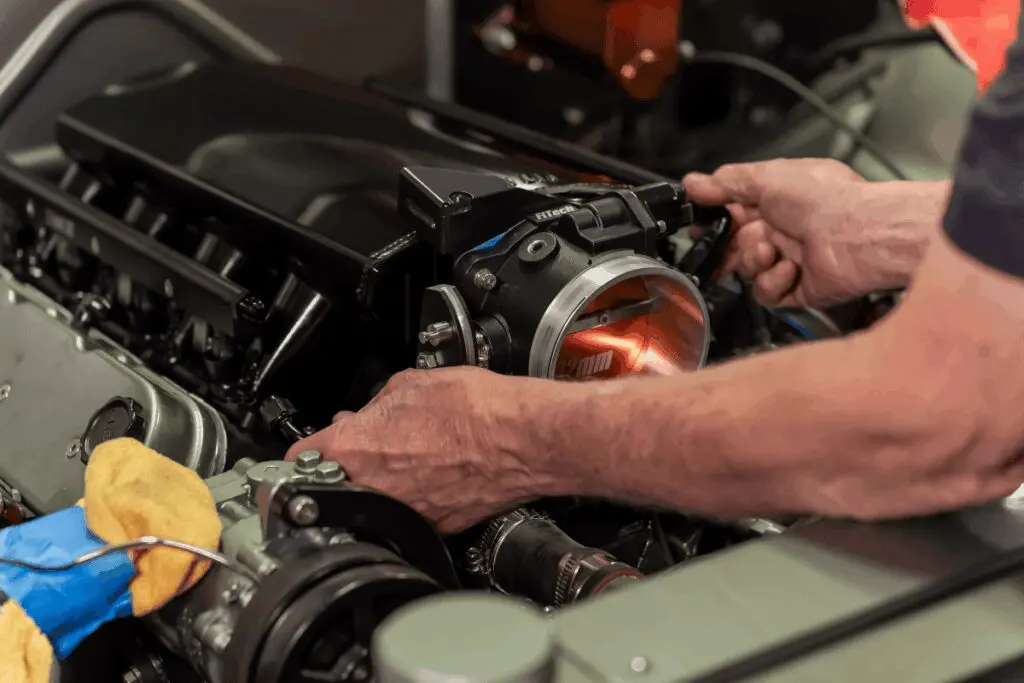
The Short Answer: EFI tuning is the process of setting up and adjusting how your ECU delivers fuel and controls ignition timing across every operating condition. Self-tuning systems like FiTech handle most of this automatically using sensor feedback, but you’re still responsible for the baseline: idle speed, throttle blade position, and cold start setup.
If you just installed a throttle body EFI system and the engine is running but doesn’t feel dialed in, your first instinct might be to start changing things in the tune. Don’t. Most of the driveability issues people chase after an EFI install come down to the initial setup, not the tune itself. Idle speed screw not set right. Throttle blade cracked open too far. Wrong information under the initial set-up. Coolant temp sensor not plugged in or reading wrong.
A self-tuning EFI system is designed to learn your engine and adjust fuel delivery on the fly. But it can only do that if the mechanical baseline is correct. This guide covers what your ECU is actually doing, what you need to set up before the self-tune can do its job, and where you can step in to fine-tune if your build needs it.
Setting the Foundation
Before you touch a single tuning parameter, the mechanical setup has to be right. Your aftermarket ECU can’t self-tune its way around a throttle blade that’s set wrong or an idle speed screw that’s cranked too far in. You should also always verify the engine condition to ensure the engine was running mechanically correctly before the upgrade
Idle Speed and Throttle Blade Position
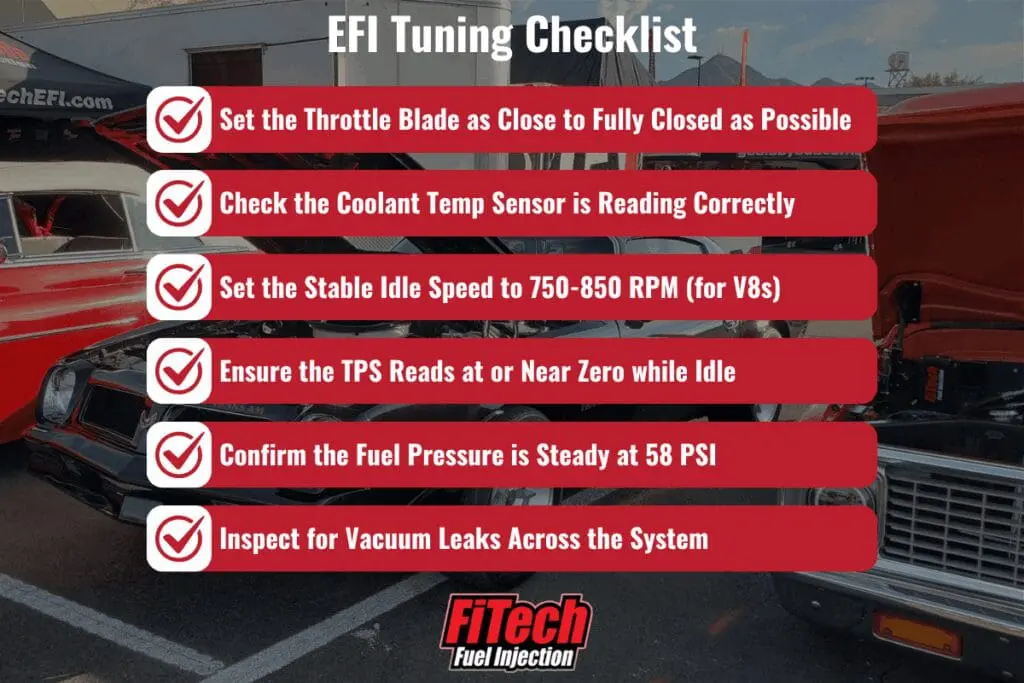
Your idle speed screw controls the resting position of the throttle blade. On most V8 builds, you want idle RPM somewhere in the 750 to 850 range. The screw sets the mechanical floor for how much air gets past the throttle blade at idle.
Here’s where people get into trouble. If the throttle blade is cracked open too far, the throttle position sensor reads it as driver input. The ECU thinks you’re giving it gas and starts fueling accordingly. Idle goes high, the self-tune chases a target it can’t reach, and you end up troubleshooting a problem that has nothing to do with the fuel map.
Camshaft selection plays a role here too. A stock cam produces strong, steady vacuum at idle, which makes setting idle speed and IAC control more predictable. An aftermarket cam with more duration and overlap produces less vacuum, and the ECU needs to account for that. If you’re running an aggressive cam, knowing your cam specs helps you set up the initial idle and IAC parameters correctly. Without that info, the ECU is guessing at airflow, and idle quality suffers.
To set it right:
- Adjust the idle speed screw so the throttle blade is as close to fully closed as possible while still maintaining a stable idle
- The TPS should read at or near zero with your foot off the pedal
- If you’re fighting an idle issue, check throttle blade position before you start adjusting fuel tables
The other common cause of idle problems is vacuum leaks. A cracked vacuum hose or a loose intake manifold gasket lets unmetered air into the engine. The ECU doesn’t see it, can’t compensate for it, and the engine runs lean at idle. If the idle is erratic and the throttle blade position looks right, check for leaks.
Cold Start Enrichment
Cold start enrichment is the EFI equivalent of a choke. When the coolant temperature sensor reads a cold engine, the ECU adds extra fuel to compensate for poor fuel atomization in a cold intake manifold. As the engine warms up, the ECU tapers the enrichment back to normal fueling.
On FiTech systems, cold start enrichment is handled automatically based on the coolant temp sensor reading. If your engine stumbles or runs rough during warm-up but smooths out once it’s at operating temperature, check the coolant temp sensor first. A bad reading feeds the ECU wrong data, and the enrichment curve won’t match what the engine actually needs. It’s a sensor issue, not a tuning issue.
AFR, Closed-Loop Correction, and the Fuel Table
Once the mechanical baseline is set, the ECU takes over. This is where the self-tuning happens. The ECU reads sensor data, calculates how much fuel the engine needs, and adjusts in real time.
AFR Targets and What They Mean
AFR stands for air/fuel ratio. It’s the ratio of air to fuel entering the combustion chamber on each cycle. For gasoline engines, the chemically ideal ratio is 14.7:1, meaning 14.7 parts air to 1 part fuel. This is called stoichiometric, and it’s the target for the cleanest, most efficient burn.
In practice, your engine doesn’t run at 14.7:1 everywhere. Typical AFR targets break down like this:
- Cruise: 14.7:1 for best fuel economy and clean exhaust
- Idle: slightly richer (lower number) for stability
- Wide open throttle: 12.5 to 13.0:1 for maximum power and to keep combustion temps safe
Running too lean (high AFR) under load risks detonation and engine damage. Running too rich (low AFR) wastes fuel and fouls plugs. The ECU’s job is to keep the ratio where it needs to be at every operating point.
Closed-Loop Correction
Closed-loop correction is how the ECU keeps AFR on target. Here’s the cycle:
- The O2 sensor in the exhaust reads the air/fuel ratio after combustion
- It sends that data back to the ECU
- The ECU compares the reading to its target AFR for the current operating condition
- If the mixture is off, the ECU adjusts injector pulse width on the next cycle
This happens continuously while the engine is running in closed loop. That’s the self-tuning. The ECU is always reading, comparing, and correcting.
The system isn’t always in closed loop. During cold start and wide open throttle, the ECU runs in open loop, meaning it relies on pre-programmed fuel values instead of O2 sensor feedback. Once the engine is warm and you’re at cruise or light throttle, closed loop takes over.
Signs that something needs attention:
- Persistent rich or lean conditions at idle or cruise
- Black smoke from the exhaust
- Surging or hunting at steady throttle
- Detonation or pinging under load
Speed Density and the Fuel Table
Most FiTech systems use speed density to calculate engine load. The ECU reads the MAP sensor, RPM, and intake air temperature to determine how much air is in the engine at any given moment. It then references the fuel table, a grid of fuel values mapped against RPM and load, to set injector pulse width.
The fuel table is built around volumetric efficiency (VE), which is how well your engine fills its cylinders with air at a given RPM. A stock small block at 2,000 RPM and a cammed big block at 5,500 RPM fill their cylinders very differently. The VE table accounts for that.
On a self-tuning system, the ECU adjusts the VE table over time using closed-loop O2 feedback. On a standalone ECU, a tuner builds it on a dyno, cell by cell.
Timing, Accel Enrichment, and Tuning Methods
Fuel delivery is half the equation. Ignition timing and throttle response tuning are the other half. This section covers how the ECU handles timing, what accel enrichment does, and when self-tuning is enough vs. when a dyno or road tune makes sense.
Ignition Timing and Knock Control
The ECU controls when the spark plug fires relative to piston position. This is ignition timing, and it has a direct effect on power output and engine safety.
- Advancing timing fires the spark earlier in the compression stroke. This gives the air/fuel mixture more time to burn and push the piston down, which makes more power.
- Retarding timing fires the spark later. Safer, but less power.
The ECU uses a timing map based on RPM and engine load to set timing at every operating point. More load and more RPM generally call for different timing values, and the ECU adjusts automatically.
The risk with too much advance is detonation. That’s when the air/fuel mixture ignites on its own before the spark plug fires, and it can destroy pistons, rings, and bearings in a hurry. A knock sensor listens for that and tells the ECU to pull timing if it detects it.
Not all FiTech systems include a knock sensor, but the Go Spark CDI box offers timing control for builds that need it. If you’re running a high-compression engine or lower-octane fuel, knock detection is worth having.
Accel Enrichment
Accel enrichment is a temporary burst of extra fuel when you snap the throttle open. It’s the EFI equivalent of the accelerator pump shot on a carburetor.
Here’s why it’s needed. When you stab the throttle, air rushes into the intake faster than fuel can follow. That creates a brief lean spot, and the engine stumbles. The ECU sees the rapid change in throttle position and adds a short burst of fuel to cover the gap until normal fueling catches up.
If you get a stumble or hesitation on tip-in, accel enrichment is the first place to look. On FiTech systems, you can adjust accel enrichment through the handheld controller without digging into the full fuel table.
Self-Tuning vs. Road Tuning vs. Dyno Tuning
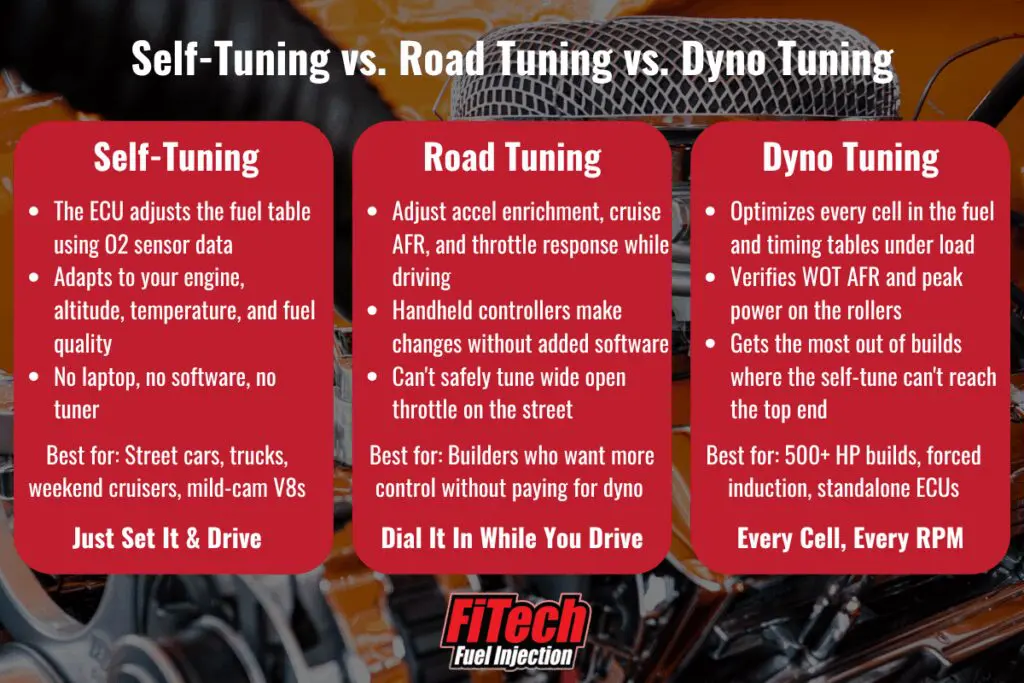
Not every build needs professional tuning. Here’s when each approach makes sense:
Self-Tuning (FiTech’s Approach)
FiTech systems use closed-loop O2 correction to adjust the fuel table automatically over time. The system adapts to your engine, altitude, temperature, and fuel quality. For most street builds, weekend cruisers, and mild-cam V8s, this is all you need. No laptop. No dyno. No tuner.
Road Tuning
Road tuning means making adjustments while driving under real conditions. It’s useful for dialing in accel enrichment, cruise AFR, and throttle response. FiTech’s handheld controller makes this accessible without professional tuning software. The limitation is that you can’t safely tune wide open throttle on the street the way you can on a dyno.
Dyno Tuning
A dyno holds the engine at specific RPM and load points so every cell in the fuel and timing tables can be optimized. It’s the best option for high-performance builds, forced induction, or engines with aggressive cams where the self-tune may not perfectly dial in the top end. If you’re making over 500 HP or running a standalone ECU, dyno time is worth the investment.
Let the ECU Do the Work for You
EFI tuning doesn’t have to mean hours on a laptop or thousands at a dyno shop. Your job is the foundation: set the idle speed screw, confirm your throttle blade position and TPS reading, and make sure the coolant temp sensor is plugged in. Once the mechanical baseline is right, a self-tuning ECU learns your engine and dials itself in. If you want to go deeper, road tuning and dyno tuning are there when you need them. Set it up right. Drive it.
FiTech’s fuel injection systems are built around this approach. Self-tuning out of the box, adjustable through the handheld controller, and backed by an in-house tech team that picks up the phone. Check out FiTech’s full lineup of EFI systems, fuel delivery kits, master kits, and more to find the right setup for your build.
 Article reviewed 04/09/2026:
 Fred Najera is the Tech Support Manager at FiTech Fuel Injection, bringing years of hands-on experience in the automotive industry. A lifelong car enthusiast, Fred has spent his career working with performance vehicles and helping enthusiasts get the most out of their builds. At FiTech, he leads the technical support team, assisting customers with installation, troubleshooting, and tuning to ensure their EFI systems perform as intended.
See more